

What follows is the first part of a talk delivered at the Symbolic World Summit in Cleveland, OH on May 14 2026. (That’s why this week’s ‘stack is late - I was on the road!) It’s a bit of an epic one, covering the alphabet as technological Singularity, the hybrid oral/written culture of the Middle Ages, memory training as a spiritual practice, and the implications of outsourcing both composition and memory to machines.
This part explains my overall thesis, why the first Singularity was literacy itself, and how the new Dark Ages are already upon us. The second describes medieval memory training and the replacement of sacred time with secular History, and the third will look at the great digital forgetting and how we can keep the lamps lit in the oncoming age of obliteration.
I’m publishing it in three parts because it was LONG! It’s also weird enough that smaller doses might be better? The image is a live sketch created by Josh’s Sketch Notes, who drew it as I spoke and amazed me in doing so, with how vivid a picture the result is of the inside of my head.
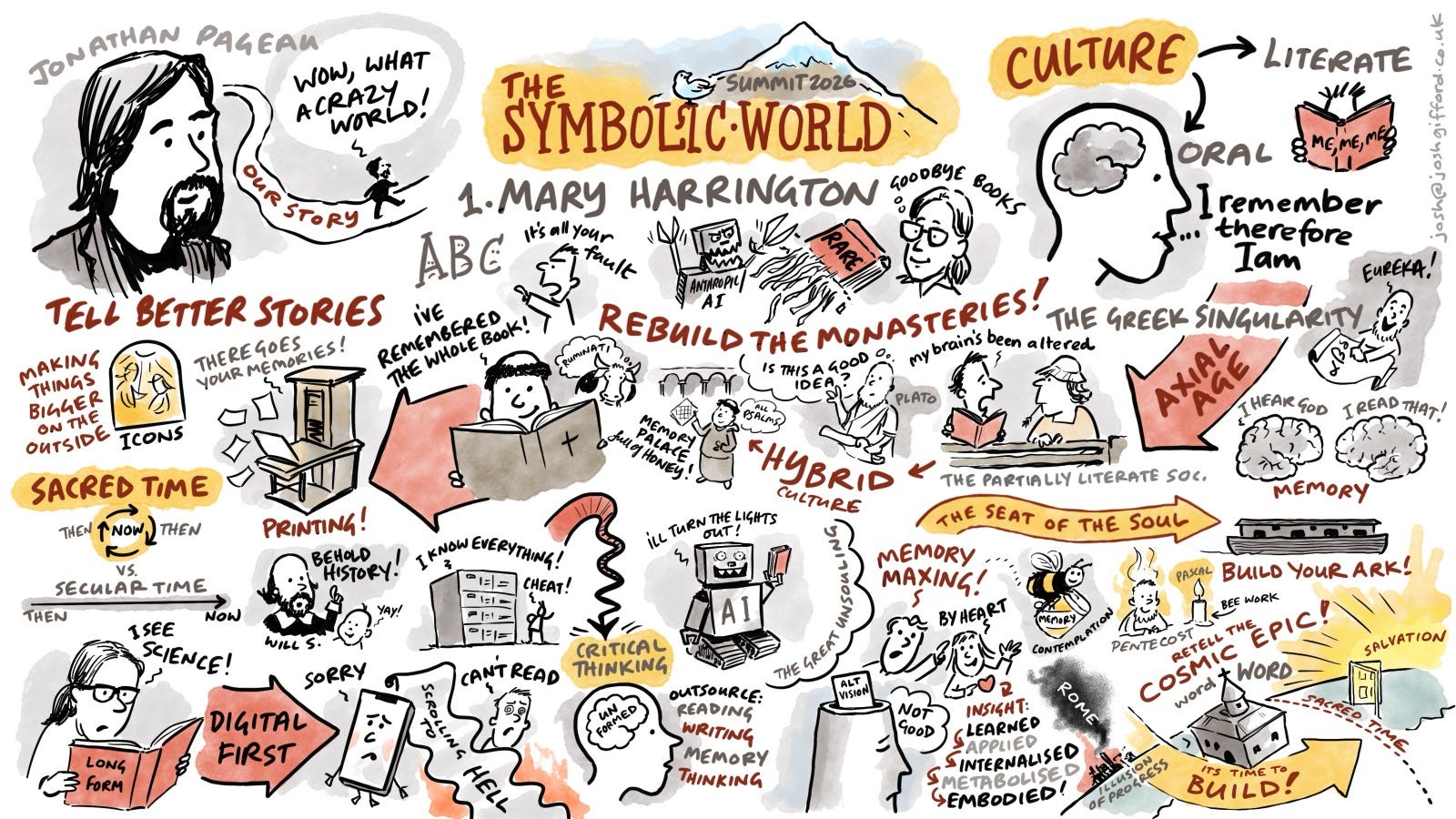
As I prepared this talk, a story began to pluck at my attention. Rare books are growing rarer; the prices are going up.
It appears that the AI firm Anthropic is buying up rare, obscure, and unusual books in huge volumes, digitising them for training data, and then shredding the books themselves. These shredded books stand as shorthand for a transformation that’s been coming for a century, but which is now happening, visibly, all around us: the end of the print era.
That is to say: the end of modernity. In its aftermath, much will be lost. We meet here, in fact, in the dimming light of an oncoming Dark Ages. I don’t think that is overstating the case. The good news is that this has all happened before. And when it did, the lamps of our long civilisational tradition did not go out, for all that the winds blew hard and cold.
Our theme for this summit is “Retelling the Cosmic Epic”. I agree that this theme is urgent, and one of the reasons I think so is because we’ve reached the end of History, and of Progress, at least as understood within the modernist frame.
What’s perhaps less well understood is that “progress” and “history” as such are, to a significant extent, cultural byproducts of an information revolution, the printing press. Print then gave us the modern era. And if we’re now fumbling our way toward retelling the story of our world, not as one of “progress” and “history” but rather of something more transcendent – a cosmic epic – this is because is the print era has already ended.
What comes after is in many respects a return to what we had before. That is, a culture where we can no longer rely on the conventions facilitated by mass literacy, to help us orient ourselves in what’s known. But the differences are important, and at present we are missing a vital component without which we may lose more, in shredding the books, than we bargained for.
In its aftermath we are going to have to re-learn some important lessons we carefully forgot, in order to become modern people who believe in “progress”. Lessons about the written word, the sacred Word, and the art of memory. It’s in this context that I chose my theme today: “Rebuild the Monasteries”.
I want to talk about monasteries both literally, as practical real-world institutions which create space for contemplation. But I also want to offer the monastery as an emblem, a symbol if you like, of a way of being that foregrounds askesis, discipline; that fuses ora et labora, prayer and toil; that understands study and learning as only one part, the first or last layer of a discipline of inner formation, ordered always toward sacred contemplation; that takes as its foundational assumption an indissoluble link between the written word and the Word of God. And, as such, recognises that encountering and internalising the word is not something we can hand away, for machines to do for us.
But as the rare book shredding story indicates, this is exactly the path our prevailing culture has chosen. I’ll talk a little about the psychological and spiritual consequences I expect this to have.
And I’ll hope to persuade you that, the urgent task of everyone who takes the symbolic world seriously is to rebuild the monasteries. Either literally or figuratively. To create spaces ordered to the word and the Word, to sacred as well as secular time. Spaces where the lamps will stay lit, even if the world falls into darkness.
The Singularity Already Happened
What’s odd about the Anthropic book-shredding story is that it was foretold in a science-fiction story, by the man who coined the concept now powering the AI evangelists: the computer scientist and writer Vernor Vinge. The story, Rainbow’s End, describes a world that’s also shredding books. It asks a profound question: what happens when we transition our knowledge to digital forms, and what if anything is lost?
But if Vinge was asking this question two decades ago, he predicted our current moment still earlier, when he coined the term “Singularity”. Vinge conceptualised this, back in the twentieth century, as a point where technological advancement would accelerate to so great a pitch that we’d merge with our own inventions, resulting in a new way of being so different as to be unimaginable.
The idea has since been elaborated by others, perhaps most famously the futurist Ray Kurzweil. This idea, that we’re on the cusp of a total transformation of everything, after which all you know will be swept away for something transcendently new, probably sounds familiar. That’s probably because in the West the prevailing culture is still ambiently Christian. And this vision includes a vivid realisation of the End Times. If the Singularity sounds a bit like the Book of Revelation, that’s because it’s much the same picture, just with computers and biotech in the place of God.
Here’s the thing though. I’m guessing no one here likes the idea of merging with our technologies. But the truth is, this already happened. Not once, but three times. The most recent was our transition to digital, from print, the shift I believe is bringing a new Dark Ages. But the arrival of print was also a reality-altering moment of merger with our information technologies. And, further back still, the very first such merger was the spread of the Greek alphabet.
In In the Vineyard of the Text, Ivan Illich argues that the history of Western cultures is inseparable from the history of our evolving relationship with the alphabet. Others, including Walter Ong and Marshall McLuhan, make the same argument. The alphabet is the foundational technology of the immense, multi-millennia civilisational arc, our shared and – yes – arguably pretty cosmic epic. A story in which this present moment is one fleeting instant.
But our relationship to it has varied a great deal, over the course of that epic. And my theme today is the way that relationship is once again in flux. And, particularly, how I believe those of us should respond to that flux, who love the word (small w) and the Word (big W).
I’ll talk a little bit about the mind-altering qualities of literacy as such, but what I want to focus on today is the long stretch of partially literate culture, that reached from St Benedict’s time to the second Singularity, the print revolution.
Then I’ll sketch some of the ways print swept that world away. Finally, I’ll make the case that the recent digital Singularity is returning us to a hybrid, partially literate culture that in many ways resembles that of the Middle Ages. But with a warning! Namely: inasmuch as this is happening, as things stand we’re less well-equipped today, technologically, to sustain ourselves in this world, than we were in the actual Middle Ages. And in this context I hope it’ll become plain why I think it urgent, either literally or figuratively, to rebuild the monasteries.