
"Irritatingly Embodied"
Notes on art salons, human trafficking, and not regretting motherhood

Hello from the book-writing burrow. I now have two chapters at near-final draft stage and I’m SO excited about how it’s coming together. Fingers crossed I’m on track to hit my goal of completing the first three chapters before Christmas, after which I’ll resume normal Substacking for another stretch. Thank you all for sticking with me meanwhile!
Three short notices this week: an innovative art sale, a news item on the wicked industry profiting from loneliness in Japan, and a guest post on “not regretting motherhood”.
Everybody Wins
First, the happy story: friends of mine have launched The Cambridge Salon, a new space supporting art and artists dedicated to the good, the true, and the beautiful, based in (you guessed it) Cambridge, UK. Founders Helen Orr and artist Katherine Leckie believe that “every skilled artwork, literary creation or musical piece that is truly beautiful, carries within it a kind of sacrament.”
The aim is to nurture and promote artists, writers, and other creators through community and events: in the founders’ words “an affirmation that beauty, fellowship, and the life of the spirit still matter in an age increasingly marked by fragmentation and distraction.”
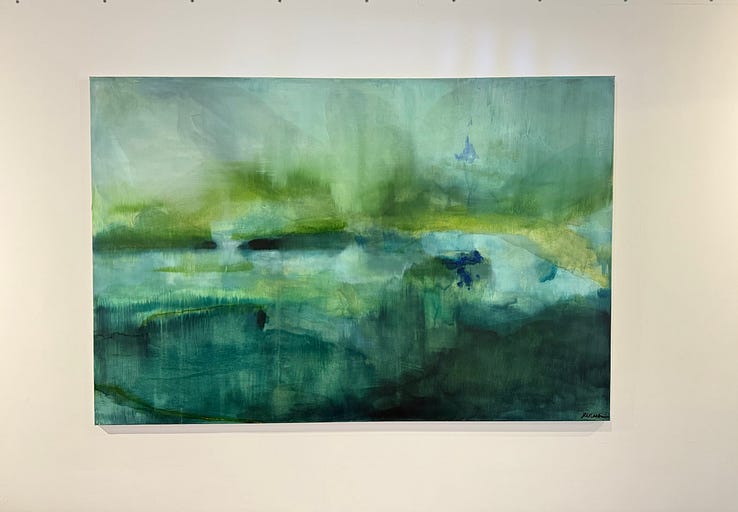
To raise funds, The Cambridge Salon is holding an inaugural art auction, beginning 8 December, using an innovative method that will pay a reward to everyone who bids. I’m not sure I understand the tech but the paintings are all lovely. Take a look!
Human Resources
A less uplifting story now Japanese women are increasingly being trafficked overseas for prostitution, according to support group Japan Refuge. Sex trafficking is of course nothing new, but what makes this story especially dark is the reason such women end up being trafficked: they have run up huge debts in “host clubs”.
A host club is an establishment where women pay per hour for male companionship. This article describes, for tourists, what it’s like to visit such a club: you pay for entry to the club, choose your “host” from an iPad menu, pay a fee to book their company in a booth for an hour, and then pay for your and your host’s drinks on top. Officially the service is non-sexual companionship, though “as with many gray area industries, options may be available in some places".
These clubs are, according to Tokyo Reporter, highly skilled at luring women in to spend extraordinary amounts of money. Women who appear particularly vulnerable and willing to over-spend are then immediately targeted by scouts for the sex industry:
“If [a woman] says to a particular host she fancies things like, ‘I want to work harder for you’ or ‘I want to have a champagne tower,’ he will introduce them to a commercial sex scout,” Shimizu says. “The scout has connections overseas. Some host clubs even have their own dedicated scouts.”
After they run up enormous debts buying “companionship” from “hosts” in these clubs, then, these women are themselves turned into a product for sale. Having accrued more debt than they can pay off through ordinary work, they’re pressured into travel overseas - typically to Canada or Australia - to work as prostitutes.
Some women have reportedly been beaten and kicked while have sex with customers, returning home covered in bruises.
“Many Japanese women can’t speak English, and they have to earn money, so they can’t say no. They find themselves in a situation where they can’t refuse even unreasonable demands,” says Shimizu.
What this represents, then, is a total commercialisation of the interface between the sexes. Of course both sexes need and value emotional and physical intimacy; but stereotypically, women tend to prioritise the emotional kind and men the physical kind. Here, a cold-blooded commercial infrastructure has emerged to arbitrage this gap in both directions: women craving emotional intimacy get into debt buying it by the hour in “host clubs”, before being themselves sold as products to men craving sex. Both emotional and physical intimacy are degraded by being thus productised.
This is the logical endpoint of the mindset that speaks of “human resources”. To the extent that any of us is available as standing-reserve, the telos of our thus standing ready for use is arbitrage of this nature. Some may be making money, but we are all poorer for it.
On Not Regretting Motherhood
Finally, a short guest post from a reader, Hestia, on not regretting motherhood. There’s a ton of writing out there celebrating how wonderful it is being a mother, and another ton of writing talking about how terrible it is being a mother. Hestia’s reflection is neither: she describes a really rough first year of motherhood - in the course of which she has suffered, endured, recovered, adjusted, healed her birth trauma, and in time surprisingly transformed her feelings about her new condition.
It’s a challenging read but to me, a moving one. Maternal ambivalence is really hard to write about. I publish Hestia’s essay not in a prescriptive spirit: please don’t infer that I’m saying to anyone “this is normal”, though it’s probably more normal than is comfortable to acknowledge for at least some women. Likewise don’t read this as implying “you should feel this way”. But Hestia has captured how, especially for some personalities, journeying psychologically to a place of attunement with a pre-verbal infant can be arduous and emotionally challenging - and still bear unexpected, wonderful fruit.
One of the pieces I often feel is missing from prescriptive “parenting” material is just this sense that women’s personalities vary just like those of men (imagine!). This in turn means that the enormous, full-body change of motherhood lands in a range of different ways, and some take to it more easily than others. Hestia has opted to share her experience of struggling to adjust, and getting there in the end.
I think she has shown great courage putting this experience into words. I invite you to read her story with an open heart.
Guest Post: On Not Regretting Motherhood
If you were to model a woman likely to regret motherhood, she would look very much like me. I had once been avowedly childfree, harbouring a special vitriol towards children in public spaces. I had severe tokophobia. I had never held a baby. I spent a good few years of my childhood convinced I should have been born a boy. I was raised by a narcissistic mother, so inherited no good template for how to be one myself, gaining instead a fun predisposition towards mental illness. My decision to have a child was mostly based on reason rather than emotion. I had no support besides my husband. By choice, I did not breastfeed, and had a caesarean. The birth was traumatic.
But despite several of my deepest fears coming true, I don’t regret it. At times though, early on, I would have said that I did. As my son has just turned one, I’ve been reflecting on my first year as his mother, and how I reconcile these contradictions.
I went into having my son knowing exactly how terrible it could be and I did it anyway. I knew all about obstetric violence, I’d read the 2024 British parliamentary inquiry into birth trauma, and I certainly knew the NHS was a mess. I knew men could be horrendous, though I was confident I’d picked a good one (and thank goodness, I had). I knew I would lose autonomy, money, status, respect, fitness, sleep. I knew I would have little family support. I knew pregnancy would force me to confront the tentative illusion I had of bodily sovereignty. I knew childbirth would undo me. I knew I would simply have to survive the first year. I knew I wasn’t built for it. And yet I did it anyway, on the suspicion that if it were even half as good as people said it is, it’d probably eventually be worth it.
In some ways, my experience was worse than I could have imagined, maybe because it is not actually possible to inhabit the days of early motherhood before you’ve jumped into the abyss, and because even for the most mentally robust and well-prepared mother, the first few months can be incredibly disorienting and depersonalising. I thought an elective c-section would allow me to control every variable, but the NHS still managed to do me harm.
Bonding took a while because of severe reflux and tongue-tie – for a good few weeks, I didn’t really want this projectile vomiting screaming baby anywhere near me. Though I’d done nothing to warrant a doting village, I had even less family support than I’d anticipated. In my first few weeks postpartum, my mother sent me pictures of meals she’d batch-cooked for herself, and while I still bled sent me texts asking, ‘How’s my baby?’ – she meant my son. We are now estranged. It is embarrassing to write this, but I had a very hard time this year and, besides my dear, dear husband, nobody was there.
Though I had anticipated this and tried to plan for it, I suffered in a way I have never suffered before. I could not really put into words the extent to which I was hurting, and I thought I regretted it all. I said as much through tears to my husband as he held our crying son. I said it like a mantra: “What have I done? What did I do? I had such a good life. Such a good life. How could I have been so stupid as to think I could do this? I regret it. I regret it. I regret it all.”
Motherhood is not a vocation that can be thought through. It is felt, it is irritatingly embodied. It is inconvenient in every way. You must slow down. You must stop. You must. After my experience in the hospital, I wanted nothing more than to remain disembodied. I had no language to describe what happened to me on the operating table – though a textbook delivery, I was dehumanised, ignored, mistreated, left in searing pain despite begging for analgesia. I encountered in that hospital what Lacan calls the Real, the dimension of experience with no symbolic armature, no narrative coherence, that resists integration into the self’s meaning-making structures. My body was no longer mine, but was instead something happening to me. I always knew I would not begin motherhood in a transcendent haze of oxytocin – I was too petrified of vaginal birth – but I did not expect to replace that entry with a rupture in the continuity of being.
Sceptical readers will think there is no real coming back from such intense despair. So how did I manage it? Unfortunately, though I tried (and still do), I did not find God. The way I understand it is that ‘regret’ was the only word I could find to make sense of such intense pain. We of course live in an unusual time where having children could be something one could choose and regret at all. So as the only script readily available to me from my time as an obnoxiously childfree feminist understood motherhood and reliance on a man as at best an unwise decision, and because in such an intensely negative emotional state it’s hard to see the wood for the trees, regret was the only option. I had done this to myself. What especially stung was that I had sought out motherhood by (mostly) rational choice, having exhausted the meaning-making opportunities available to me by my late 20s. So, to me, motherhood was a great meaning-making endeavour. To then have my entry into motherhood marked by the catastrophic loss of meaning made me grapple in the dark for something that could metabolise that loss: better, then, for it never to have happened.
I am not sure there’s much point in detailing all the changes that made life go from unbearable to bearable, from bearable to joyful. I pursued EMDR therapy for my birth trauma, and in 3 sessions, my emotional reactivity reduced so completely as to be miraculous. I no longer thought about the birth, and concluded I’d do it again. I met other mothers. My son started to make more sense to me, and he got easier. I caught up with myself. Days had meaning and structure. I began to locate myself in the Symbolic again: I found a way of making sense of everything, of my new place and position, of my son’s relationship to me. I narrated everything ceaseles[Author]sly until it all began to make sense.
They say not to make any major decisions in the first year of your child’s life. I would probably add that during that time you shouldn’t listen to a word a mother says either. It turned out that my admission of regret was transient and complicated. Rather than being the final say, it was instead an imperfect way of attempting to put into language what cannot be symbolised, an imperfect placeholder during a crisis response extant only while I struggled to make sense of the rupture of early motherhood amid family estrangement.
I am still the same woman who regretted her choice to become a mother, and on some days – say, when my son is projectile vomiting everywhere – I still feel a twinge. But it is not a narrative that really makes much sense to me anymore on closer inspection. As I enter my son’s second year, I feel an electric excitement for everything in his sweet little life that is yet to come. I could pen a thousand very boring words about the wondrousness of this child, the trusting depth in his gaze, the cheeky smile, the way he yells at the top of his lungs when he barrels across the room, the intensity with which he studies the smallest things. The hormones finally got to me. They really are that powerful. But I must stress that doesn’t make any of it less real, nor render my revised conclusion the desperate post-hoc rationalisation of a traumatised woman. I am those hormones, they are me. It’s hormones all the way down, baby. This is my life, and I have a son, and I am his mother, and this, to me, is bliss.
The fact that you feel the need to mention in relation to your guest writer, "Don't read this in a prescriptive way!" confirms something I've always felt about Anglophone cultures (America, in particular, where I lived for 30 years): that whenever we discuss a state belonging to someone, unless we openly reject it, there is an assumption that we are proselytizing for that state to be a model for others. (Forgive me for not being very clear, but it's difficult to explain!) I noticed this because this assumption is totally absent in the culture I come from (Romanian) and in my second-acquired culture (French). It's as if people can't simply accept uniqueness--as if they need to imagine a category behind it (a reproducible model).
As I think the author knows, one of the worst things about early-parenting suffering is that it often detonates a person's ability to imagine and feel long-term. This is no-one's fault. I have nothing but compassion for women in Hestia's situation: it is terrible to feel and experience these things, and the family isolation is particularly galling. But I wish she could genuinely feel what's coming. I know that it's impossible to feel it, but the difference between now and 4 years from now (and 5 years, and 10, and 25 years from now) is almost impossible to describe. The love, friendship and profound existential meaning is truly overwhelming at times. Not that I would dare to say that it makes anything "worth it" when I can't experience the same traumas, but it is all coming. Hang in there!