

This is the second of a three-part series on literacy, memory, and monasteries, originally a keynote address at the 2026 Symbolic World Summit in Cleveland, OH on May 14.
Part 1 is here. In it I described how the “Singularity”, the moment of merger with our digital information technology, has already happened - but wasn’t the first such event. The first was literacy itself, circa 300 AD, which brought a new capacity for abstraction along with a new fear that writing would destroy memory.
This second part looks at what actually happened to memory, during the 1,800-odd-year period between literacy and the printing press. In brief: not so much destruction as increasing sophistication, and - especially after the fall of Rome - a convergence of memory technology with Christian spiritual practice, in monastic life. Then I look at what happened when the printing press made the art of memory obsolete.
The final part, published next week, will look at the implications of, perhaps, returning to more medieval levels of general literacy - but, this time, without (at least yet) having established a comparable culture of trained memory.
Manuscript culture
What’s important to grasp about the world after the first Singularity is that it was literate, but also not. It was a hybrid culture, where an elite learned to read, and developed astonishing capacities for abstract thought – but the ordinary folk remained in a mostly oral world of folklore, mythology, and spoken-word cultural transition. Fo.r as long as the written word remained comparatively rare, and materially fragile, what happened was not the obliteration of memory, but a convergence of the written word with a new capacity for abstraction, and the development of trained memory.
The technique developed in the classical world as a component of statesmanship would survive, both as technology and also spiritual discipline. Its milieu, across Western Europe, was more than a thousand years of monastic manuscript culture. But to understand this at all, we need to understand this relationship to memory.
Even if structured – for monks, at the level of daily prayer, memorisation, and recitation – by the written word, the material fragility and rarity of actual texts itself shaped that textual culture.
Most people couldn’t read, and didn’t need to. These lived in the oral world of patterned, mythic, ritualised, spoken-word wisdom persisted, coloured by visual signs and symbols. For those who did read, meanwhile, from classical times, the art of memory was an essential part of education.
Eddius Stephanus recounts how the Northumbrian St Wilfrid, born a little later than St Benedict, updated his stored memorisation of the Book of Psalms on a visit to Rome, in line with the version currently in use. Now, to us, the idea of memorising the entire Book of Psalms probably feels impossible on its own. St Wilfrid was able not just to do this, but to make minor adjustments to the text stored in his mind.
To do this, St Wilfrid used a protocol that’s fallen almost entirely out of use since the arrival of print: the art of memory. Along with Latin as a living common language, memory is the most important, missing, mystery keys to the Middle Ages; the reason that entire culture feels both familiar but also foreign.
Between St Benedict and the Gutenberg Bible, and even some way beyond Gutenberg, if you were a scholar “studying” didn’t primarily mean collecting a physical bookshelf. It meant training your memory, and then filling that trained memory with stored ideas that you could recall, manipulate, and think with.
The beehive
In the woodland where I walk the dog most days, there’s a fallen tree near one footpath. I often pass that way deliberately, to visit the swarm of wild bees whose nest is in its hollow trunk, and watch them fly in and out with their loads of sweet treasure. In the Middle Ages, the honeycomb was a familiar metaphor for the practice of trained memory; knowledge as sweet nectar, gathered, distilled, and stored in the orderly cells of the honeycomb. Other common metaphors included a classical building; a treasure house (that’s where we get the word “thesaurus” from); a grid; a field.
Hugh of St Victor, a twelfth-century philosopher and theologian, describes how novices in this practice should first visualise a row of numbered spaces, stretching into the distance, and then practice “darting” from one such space to another at random without losing focus. Having developed this ability, trainee mnemotechnicians might use such grids to “store” important elements of Scripture, according to theme.
The contents of authoritative books were mostly stored as ideas, rather than verbatim, and marked mentally with imagistic “tags” for ease of recall. Skilled practitioners could memorise the contents of whole books thus, in a kind of multi-storey mental spreadsheet, teeming with colourful visual cues and navigable backwards, forwards, or otherwise at will.
I’ve experimented in a very small way with these practices, which I use to memorise interview questions. I picture a series of “places” within my familiar woodland and visualise questions as funny scenes in each location. The more absurd and vivid the imagery you use to tag an idea, the easier it is to recall. In turn the absurd tags leave a trace in the ideas themselves, and sometimes produce lateral associations of their own. It’s very effective: I can remember whole series of interview questions from several months ago, that would have long since vanished from my mind had I just written them down.
This is the context in which we should understand the vivid surrealism of medieval allegory, and the super-abundant sense of symbolic richness in premodern and early modern prose. The visual culture this practice produced is everywhere in medieval manuscripts, once you realise what you’re looking at: funny little doodles in the margins, ornate capital letters, colour-coded section heads and so on. It’s all there to add visual cues to aid memorisation and recall. Even the most abstract ideas came, in the Middle Ages, trailing a comet-tail of mingled sacred and secular associations, that were apt to take on lives of their own around the central ideas. If you were a scholar, most of scholarly life was contained more in memory than on your bookshelves.
With practice you can file astonishing amounts of knowledge in this way. Memorising the Psalter like St Wilfrid was kids’ stuff, and the average student was expected to have the whole Psalter by heart in about six months. Hugh would have laughed at my clumsy beginner mnemotechnics. Advanced practitioners developed complex, multidimensional mental models using this technique: Hugh describes one such, modelled on Noah’s Ark, that modern researchers have estimated would require 220 square feet of paper to render in readable form.
Meditation
All the way back into classical times, memory was understood as having an ethical dimension. For Plato, the mind “remembers” universals in perceiving their imperfect realisation in the world. For Cicero, more practically, memory is foundational to prudence. For Augustine memory is the seat of the self, and mirrors in microcosm God’s gathering and ordering of all things, into salvation history.
For monastic culture, the micro- and macrocosmic aspects of this correspondence come together, in the meditative practice of memorising God’s history of salvation for sacred meditation. Just knowing Scripture was only the first level. Hugh’s Ark, for example, was simultaneously a mnemonic visual, and also a foundation for historical, moral, and allegorical meditation, levels of understanding attained as you make the learning by degrees your own: metabolise it. First, you remember the literal details; then you make that learning useful; finally, it becomes so completely digested in “the belly of the mind” that it orders your being habitually.
Again and again we find the analogies are not mental but visceral: the heart, the stomach, the guts. A common term for this meditation was “ruminatio”, literally to ruminate or chew like a cow: not just reading but memorising, digesting and absorbing precious forms of words. Memory lives in the belly, as for St Augustine. Bernard of Clairvaux says in a letter that for those who prepare their interior ear “the voice of your God will be sweeter than honey”. For Gregory the Great, “Sacred Scripture is sometimes food, sometimes drink for us”. “the sweetness of holy understanding” is, for him, “honey indeed”.
The real fruit of the practice is ethical formation, and – with practice – a profound form of meditation on the materials thus stored. Hugh writes: “Thus you may learn from an external form, which we have visibly depicted, what you ought to do interiorly, and when you have impressed the form of this pattern on your heart, you may rejoice that the house of God has been built in you.”
This kind of meditation draws on a foundation of memory, acquired via reading, but is not bound by it: for Hugh, meditation “delights to range along open ground, where it fixes its free gaze upon the contemplation of truth, drawing together now these, now those causes of things”. The beginning of learning, he says, “lies in reading but its consummation lies in meditation”.
All of monastic life was, as Illich calls it, “a carefully patterned framework” for memory, as this kind of embodied process, of ethical formation and spiritual meditation. The Latin word used was vacare, which doesn’t really translate directly but connotes both freeing and creating space. Even as kingdoms and empires rose and fell around them, wars were fought (and sometimes libraries burned), to the extent that these living “treasure houses” of knowledge continued to ruminate, the lights did not go out altogether. In their scriptoria books were preserved; in their hearts the word (small w) and the Word (big W) formed part of the same, vividly coloured, embodied sacred whole.
For those monks in the last Dark Ages, toiling in their vegetable gardens, tending their bees, and praying the Psalms, all of life was ordered toward the time, and the silence, needed to form a mind sufficiently ordered to contemplate the larger, divine order of God’s design.
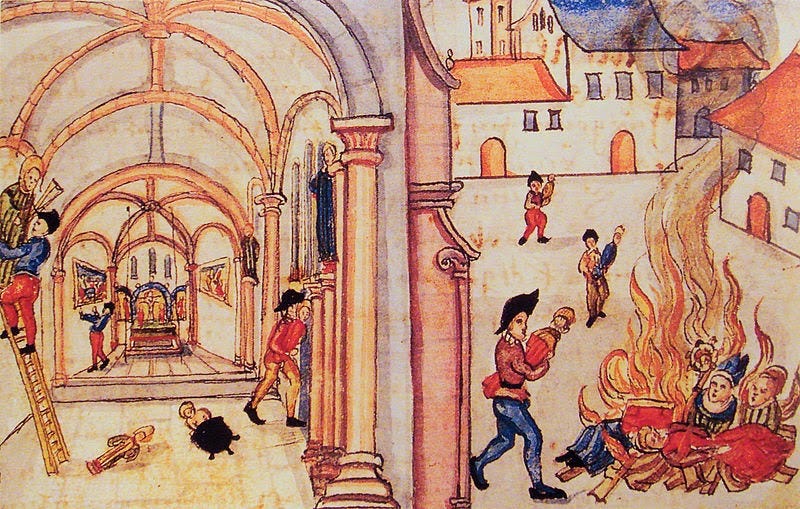
Burning the Memory Palaces
The printing press killed the art of memory. Not straight away, but within a few centuries. It did this not out of malice, but largely by making written materials cheaper and quicker to produce, and more reliable and accurate. As a result there were more books; now scholars could get their own copies, rather than travel to a book and memorise its contents.This had a number of consequences, but for us the most important one is that it changed the whole culture’s relationship to time, memory, and history - by rendering the art of memory obsolete.