

A young man experiences healing at a holy well in Ireland; Our Lady of Guadaloupe speaks to a young pregnant woman through “a tear in the world”, saving her life. An artist finds his way from a secular upbringing, through 12 years of monastic life, to lay married life as an icon painter. A composer reframes artistic creativity through the story of the Annunciation.
My family has grown to recognise the sound of a new book dropping through the letterbox. They tease me: “What did you order this time?”. But sometimes books arrive unbidden, and often these are the nicest surprises.
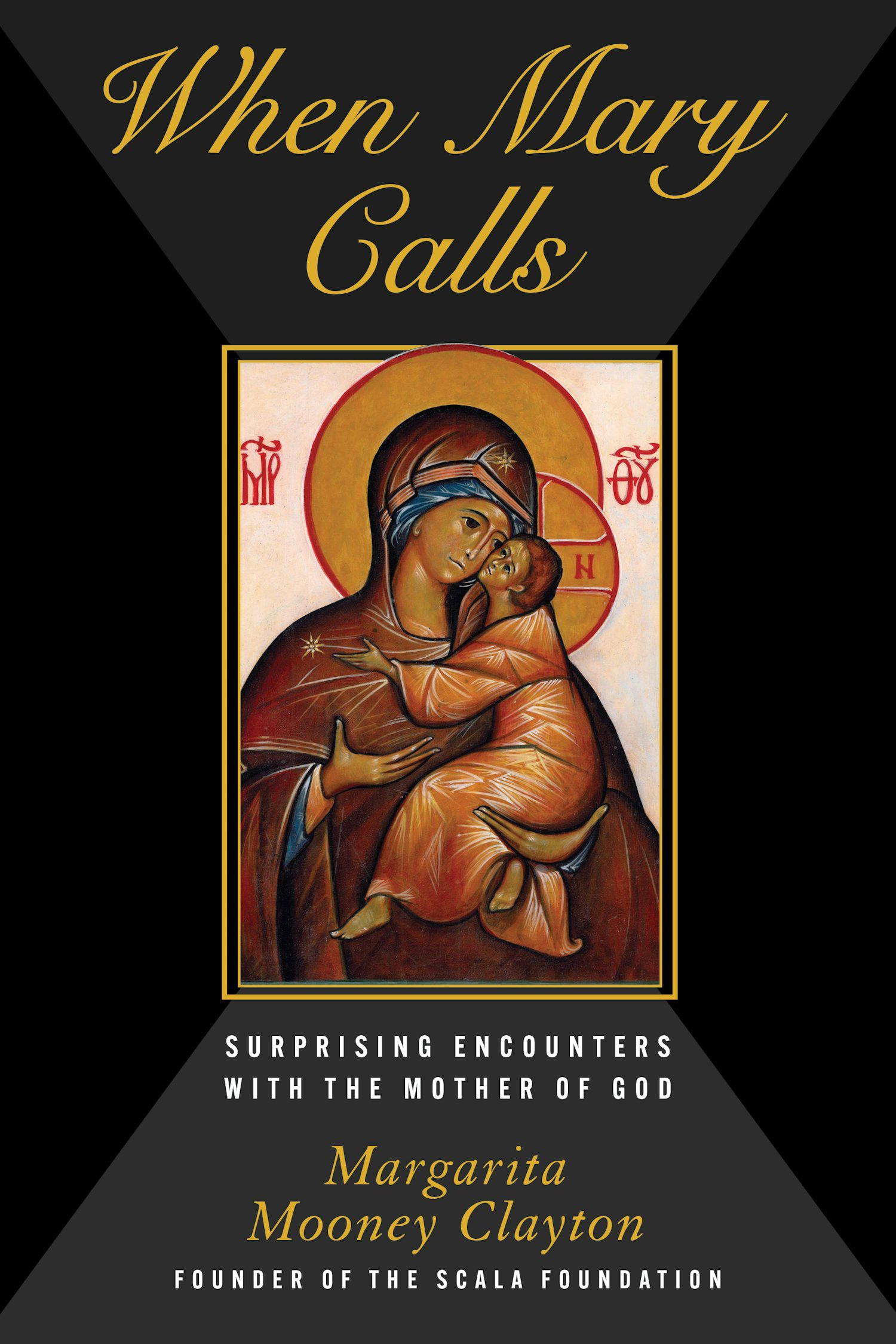
This week’s unexpected gift was a new title, by Scala Foundation founder Margarita Mooney Clayton. When Mary Calls is a collection of “Surprising encounters with the Mother of God”: personal stories of encounter with Mary.
Occasionally I get a reader grumbling, at this newsletter, about my creeping into explicitly Christian themes. But given how often I write about the “mother-shaped blind spot” how long can I really avoid writing about Mary? (The mother of God, I mean, not myself.) Once a central figure of Christian iconography, the veneration of Mary became deprecated in the great religious upheaval of the Reformation and is now viewed as a bit odd unless you’re Catholic or Orthodox. But over recent years I’ve come to feel, increasingly strongly, that the “mother shaped blind spot”, a central theme in my writing, is deeply bound up with her disappearance from mainstream Anglophone culture.

In today’s secularised world we don’t tend to frame this topic in such explicitly religious terms. We generally debate “gender” in secular, materialistic terms, and the Reformation was half a millennium ago now. And anyway wasn’t it all overall for the best? At the time, the turn against veneration of saints and icons was moved by a sincere belief that such practices were idolatrous. In 1538 Thomas Cromwell, the man who on Henry VIII’s behalf led the dissolution of England’s monasteries, issued a series of injunctions to English churches including a prohibition on
wandering to pilgrimages, offering of money, candles, or tapers to images or relics, or kissing or licking the same, saying over a number of beads, not understood or minded on, or in such-like superstition; for the doing whereof, ye not only have no promise of reward in Scripture, but contrariwise, great threats and maledictions of God, as things tending to idolatry and superstition, which of all other offences God Almighty doth most detest and abhor, for that the same diminished most His honour and glory.
But the purging of icons also meant, in practice, the radical de-centering of Marian theology in favour of something more verbal, less imagistic, more abstract.
Is it a coincidence that this spiritual, theological marginalisation of Mary was followed not long after by a material, technological marginalisation of women? Perhaps, perhaps not. Either way, by the middle of the century following the Reformation, the great technological project of modernity was well under way. And as Ivan Illich has shown, this project of modernity baked the marginalisation of women in, at a structural level:

And yet.Mary appears to be returning now - even, as Clayton recounts, among secular, agnostic people. The stories in When Mary Calls encompass Greek Orthodox, mainline Protestant, and even wholly secular individuals, who found themselves drawn toward Mary’s motherly presence and through it toward healing and transformation.
The stories encompass public and private figures, including an intimate account by Tammy Peterson, podcaster and wife of the public intellectual Jordan Peterson, of her her journey through cancer diagnosis, remission, prayer, and Christian conversion.
Throughout, Clayton reflects on her own religious formation, biography, and relationship with Mary. The result is a gentle, careful work of ecumenical restoration, whose author is both courageous and vulnerable in offering her own relationship with Mary, as a prism through which to refract these other stories.
I was moved by the author’s own account of struggling toward forgiveness, as her volatile, military-veteran father lay dying. At a more abstract level, there’s much ponder in the chapter on the Scottish composer Sir James MacMillan, who reflects on Mary as a more potent template than Prometheus for a post-secular understanding of artistic creativity:
Both accounts of divine influences on human creativity - Prometheus and Mary at the Annunciation - share a sense of mysterious divine inspiration at work in the world. But in the Promethean understanding of creativity, the human with inspiration can turn his back on God and do whatever he wants. In contrast, an artist who takes seriously the meaning of what happened at the Annunciation humbly extends that incarnational moment into his art.
So what might it mean, then, if people are now apparently re-acquiring the desire for, and capacity to engage with, figures of veneration such as Mary?