

This is part 3 of 3, on digital reading and inner life. Part 1 is here, and talks about the transformation of our inner lives by switching from print to electric media consumption, especially digital:

Part 2 is here, and talks about how largely-unconscious patterns of scrolling act as a subtle but powerful character-forming force:

For this third and final part I promised more practical notes on cultivating cognitive sovereignty. Reflecting on how to approach this, I realised that instead of sidling around the point I should go straight at it: in the sense of preserving a mind not wholly colonised by algorithms, “cognitive sovereignty” is by definition not a secular practice. Far from being exhausted by the abstract and rather utilitarian idea of “cognitive sovereignty” we’re talking about something much more profound than just propaganda, or being exploited by grifters: everyday liturgical life. That is: to the extent we engage with the internet, we are already praying.
Everyone knows the little glowing screen is an attention sink. Look around you on any busy street: most people stumble along, device in hand, eyes rapt. But at the Pusey House conference where I delivered my recent talk on re-enchantment, the Revd Dr Matthew Burford made an argument that crystallised the implications of this. Rev Burford, a college professor and pastor, argued that attention is everything - for, he argued (I’m paraphrasing lightly) that what we attend to, we grow to love. What we love, we wish to protect. What we wish to protect, we create institutions to defend.
You can probably see already why this is germane to modern-day doomscrolling habits. If Rev Burford is right, how we allow our attention to be shaped, including by our technologies, is of profound moral significance. More plainly: how and where we choose to direct attention becomes, organically, a form of prayer, that will in time organise everything we do. Thus, to the extent that scrolling colonises attention, scrolling is a form of prayer.
To what, then, is everybody praying? This is the classic xkcd cartoon about the experience:
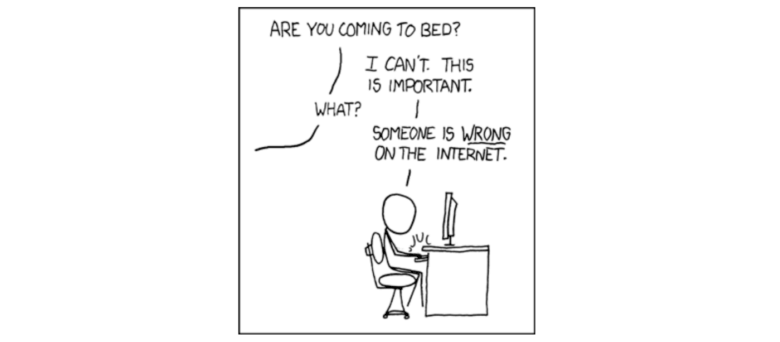
It’s funny, but actual experience can feel like having been taken over, occupied, invaded by a chaotic and often emotionally hyperstimulating argument. The emotions are often (indeed usually) dark. Indeed, those impulses most commonly activated by clickbait content have an uncanny resemblance to those an older age called the Seven Deadly Sins: Pride, Lust, Envy, Gluttony, Avarice, Sloth, or Anger. Ego conflicts; thirstposting; lifestyle brags; moneymaking scams; bedrotting; ragebait.
Here are the Seven, painted circa 1500 by the remarkable Hieronymus Bosch:
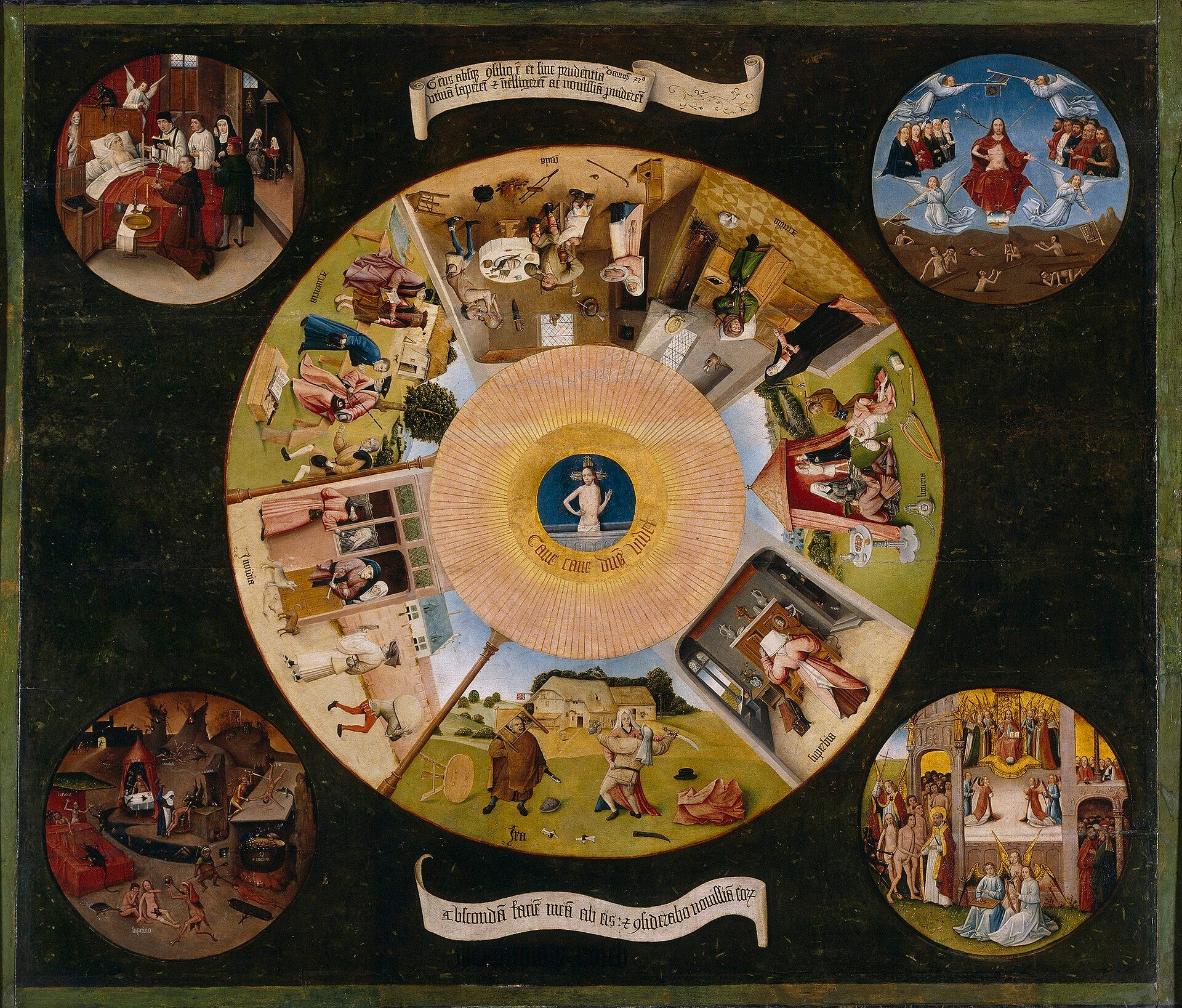
What does it mean, then, for everyone to spend hours every day absorbed in a digitally led liturgy ordered to the Seven Deadly Sins? The implication, if Rev Burford is right, it’s spelled out in Bosch’s painting, by the images in each corner: Death, Judgement, Heaven, and Hell. We might venture to suggest that the bottom left-hand corner, is a vivid depiction of the likely cultural effect of forming our collective attention through Pride, Lust, Envy, Gluttony, Avarice, Sloth, and Anger: in the most literal imaginable sense, a living hell.
In my own talk at at Pusey House (and in previous posts here), I touched on a personal insight: that in my experience the only reliable antidote I know to internet poisoning is prayer. By “internet poisoning”, I mean the uneasy way, after too much scrolling, you can feel as though some online argument has somehow come to inhabit your mind, even to the point of becoming intrusive or an obstacle to staying fully present in matters that need your attention. But if the scroll really is a form of wrongly-ordered liturgy, it makes perfect sense that the most efficacious remedy would be taking steps to order it more right.
To be clear, I don’t think it’s necessary to embrace the whole Liturgy of the Hours (though I do actually know one extremely online thinker who is on that road). But rightly-ordered liturgy implies not just freeform pleas to God, beneficial though these often are, but also a measure of structure: fixed forms of words, learned by heart, regularly rehearsed in conjunction with suitable meditation. In my experience taking this kind of structured approach helps, by degrees, to re-shape daily patterns of thought from the comparatively passive, free-floating, and vulnerably un-buffered doomscrolling mode, to one that’s more active, more vivid, and un-buffered but still centred.
To use a rather prosaic metaphor, they’re just better and more life-giving algorithms for attention, than the ones on offer from Mark Zuckerberg or Elon Musk. And in this sense, a prayer practice is not just a cure for internet poisoning, but an active, pre-emptive discipline for guarding against future dis-order.