

I know: I’ve been quiet this last fortnight. After a savagely busy first couple of months of the year I was poleaxed by illness, then rescued from it by a week’s family holiday in Athens. But I’m back!! and full of beans!! and exclamation marks!! and have so much to tell you about my trip, and how eerily it dovetailed with other dimensions of my current thought-world.
First, and also (you’ll see why) relevantly for this week’s topic, some news: I’m thrilled to share that I’ve joined Socrates in the City as a guest interviewer for 2026. Under that banner I’ll be interviewing brilliant, wise, and insightful guests from the worlds of history, faith, philosophy, politics, feminism, art, culture, and more. (Making the first of these videos is part of why my first couple of months has been so busy!)
Here’s the very first:
New interviews go live every two weeks - do check them out.
Now: Athens. It was my first visit. I have never seen somewhere so thickly over-written, in architectural terms. England often feels to me like palimpsests overlaid on palimpsests, with half-timbered medieval structures absorbed into high imperial ones, and this all jumbled with bleak postwar concrete and the dizzy fantasia of global replacist glass.
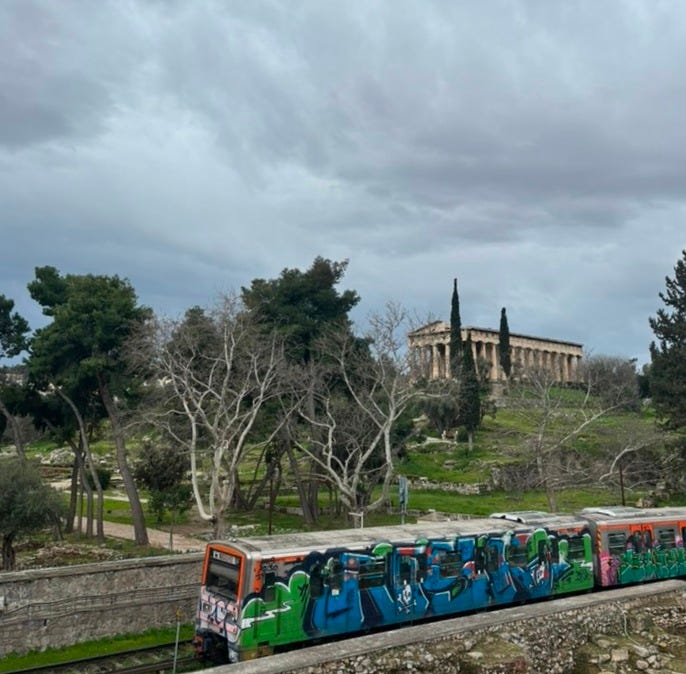
Athens, though, knocks my homeland into a cocked hat. Britain’s ruins span two millennia; the stones of Athens saw the very age of heroes. There is so much history here that you can’t avoid building on it, or sometimes through it: near the historic centre, the metro line passes by, over, and through ancient ruins, with graffiti’d trains rattling past the ancient Temple of Hephaestus:
A few days before the trip, I interviewed the classical scholar Spencer Klavan for Socrates in the City. You’ll have to wait till May for the video, but amidst a marvellously rich discussion we touched on Tertullian’s famous question: “what hath Athens to do with Jerusalem?”. Spencer’s view is that the moment when Athens and Jerusalem came together - the fateful instant that, he argues, marks the foundation of “the West” as we know it - is recorded in Acts 17, which details St Paul’s visit to Athens.
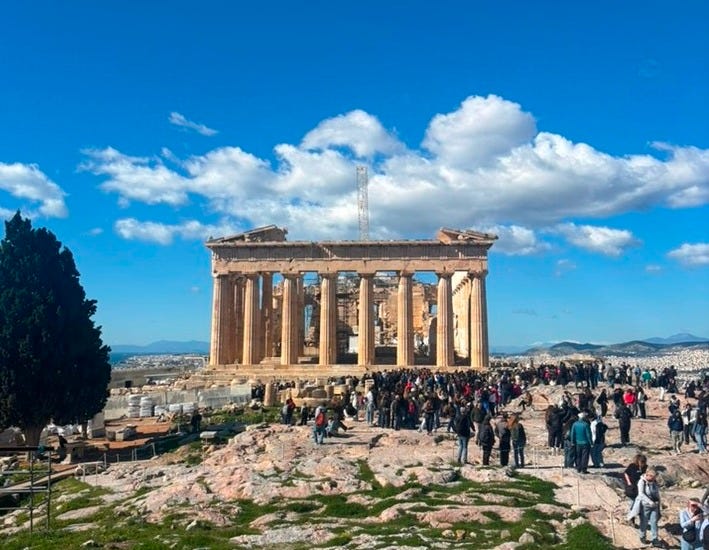
There, St Paul preached to members of the Areopagus, a prestigious governing body, and made his first converts including St Dionysius the Areopagite, who now gives his name to Athens’ Catholic cathedral. To step from that conversation to standing on the Areopagus (the Hill of Ares) itself, a few days later, felt like falling through a wormhole in time and space. I didn’t take a photo, but the sense of worlds within and behind worlds was intense. Facing the Areopagus, you stand with your back to the escarpment that leads to the Acropolis, capped by the Parthenon, a structure so laden with history and myth, with the dreams and yearnings of entire cultures, that space itself seems to bend around it.
But this isn’t just about my holiday snaps. I want to talk more about about how history and memory can bend space and time. To this end, I want to pause (warning: more holiday photos incoming!) at one of the much younger (!!) buildings in Athens’ protracted history: the Church of Panagia Kapnikarea, an 11th-century structure located in the centre of what is now a concrete shopping square, one of the oldest continuously in use churches in Athens.
Visiting this church is the most vivid experience I’ve ever had, in the physical world, of space not working quite the way geometry says it should. Here it is, with Guess Jeans and Birkenstock shops and concrete office blocks in the background. Doesn’t it look tiny?
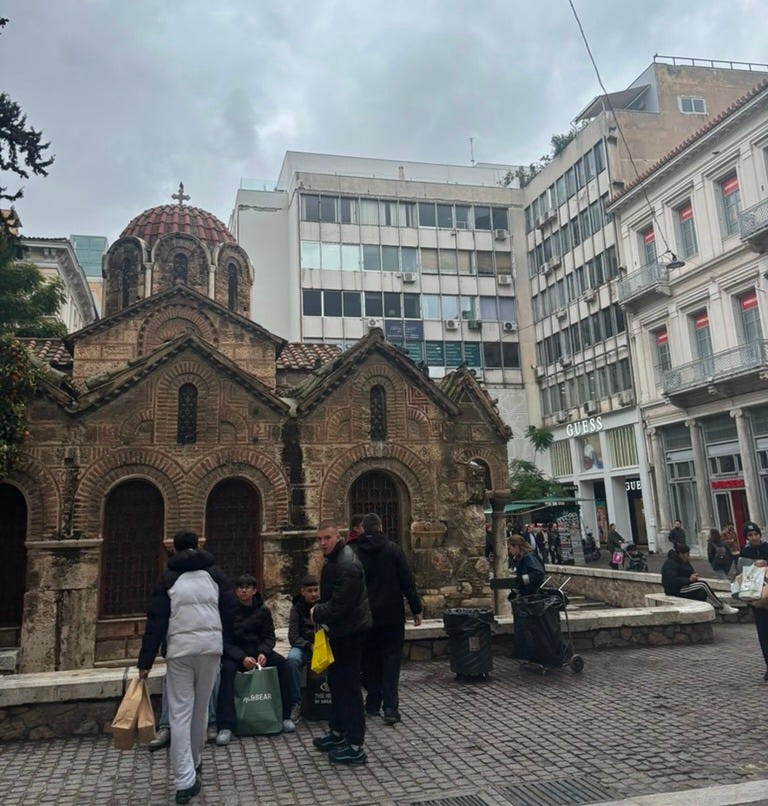
And yet - I swear this on my life - when you step through the door, you instantly realise this church is bigger inside than out.