

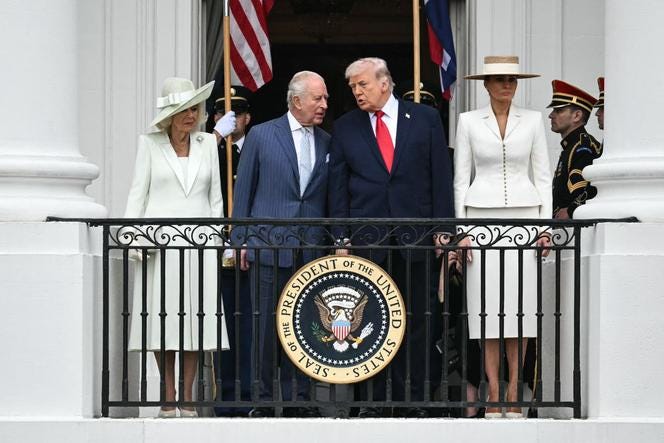
Did Donald Trump just dismantle “whiteness”? Last week, in his remarks welcoming King Charles III to Washington for a state visit, Trump made a fulsome acknowledgement of the ancestral, cultural, and historical genealogy linking America to Britain:
Long before Americans had a nation or a constitution, we first had a culture, a character, and a creed. Before we ever proclaimed our independence, Americans carried within us the rarest of gifts: moral courage, and it came from a small but mighty kingdom from across the sea. For nearly two centuries before the revolution, this land was settled and forged by men, women who bore in their souls the blood and noble spirit of the British. Here on a wild and untamed continent, they set loose the ancient English love of liberty and Great Britain’s distinctive sense of glory, destiny, and pride, and that’s what it is: glory, destiny, and pride.
It was a far warmer account of my country’s disposition and achievements than any I’ve seen uttered by a Brit recently. Trump went on:
The American patriots who pledged their lives to independence in 1776 were the heirs to this majestic inheritance. Their veins ran with Anglo-Saxon courage. Their hearts beat with an English faith in standing firm for what is right, good, and true.
What’s so intriguing about this move is the way Trump pushed back against extremes in two directions. For the far Left, no ethnocultural differences are admissible among people of Caucasian heritage, unless as a kind of biological mark of Cain: against this, Trump had warm words for the English as a distinctive people and history. Conversely, for the far Right, “white people” is a meaningful group, to be defined in opposition to the the subaltern Other even as internal differences are erased. Against both these, Trump told the story of the English, not as either emblematic of a homogenised white oppressor class, or submerged into the mirror-image superior macro-group but as a people in our own right.
Speaking as an Englishwoman, I found this pleasant but wholly unfamiliar, not least because the prevailing respectable consensus in Britain is that no such account of England is available. The usual form this takes is tedious arguments about how we define “Englishness”, whether it’s a purely civic thing, or a dogmatically ethnic one, whether someone whose parents came from (say) the Caribbean, or Mirpur, can be “English”, (Suella Braverman says no, David Lammy and Shabana Mahmood say yes) et cetera and so on.
In sum, the respectable consensus seems to be that this country’s population has been historically so porous, and imperially so predatory, that it simply cannot (or alternatively does not deserve to) be defined. Relatedly, it is sometimes asserted that Britain has always been “a nation of immigrants”. Though demonstrably false, this has become so entrenched it’s received opinion in some circles:

If you were to ask an average keyboard warrior why these ideas have taken root, you’d probably get an answer ranging (depending on the respondent’s political priors and level of extremism) from “whiteness” through “wokeness” to “ethnocide”. But I think there are two much less paranoid drivers of this strange self-erasure, both of which are linked to the story Trump told, about the expansionary spirit of the English. In other words: it’s a byproduct, in overlapping ways, of the American Empire, and also of the British one.