Midweek Quick Take: Is Instagram Catholic?
Post-literate image culture and the zoomer revival

Is the surge in American Gen Z conversions to Roman Catholicism in part due to the comparative friendliness of Catholicism to the image? Julia Yost argued recently that this is more congenial to the image-first online formation of today’s youth than Protestantism:
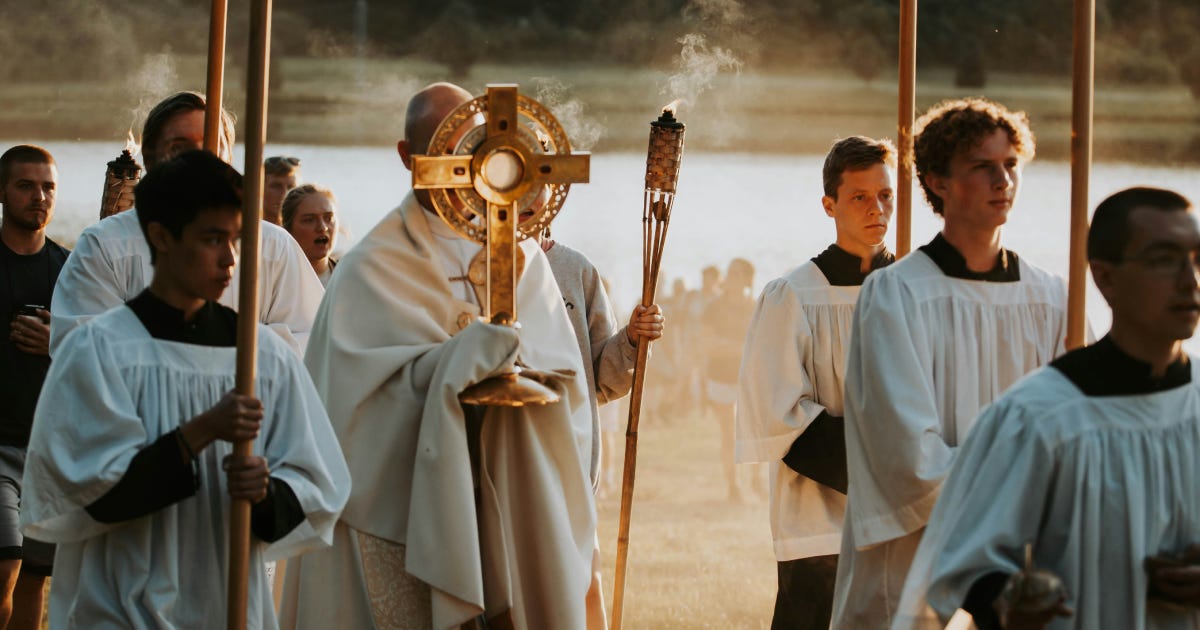
Protestantism, which began as a revolution against idolatry — the whitewashing of church interiors, the stripping of altars — has image-aversion in its DNA. The visual language of American Protestantism is accordingly limited. White steeples, Puritan clothing, snake handling: not much for an influencer to work with. Catholicism has icons and incense; rosaries, chapel veils and ashes; priestly black, cardinal red and papal white. “Catholic drip” content, downstream of “Conclave” (the 2024 film about a papal election, praised for its costume and production design), enjoys intense engagement. An old stereotype has it that Protestantism is for people who read books, and Catholicism is for people who want spectacle. Say hello to Gen Z.
Matthew Schmitz took this further, arguing that Catholicism is booming because “we’re entering a post-literate age” that favours “image-rich” Catholicism over “text-based” Protestantism. I think there’s something in these arguments, and it’s certainly true that the image-first and video-first nature of the internet is effecting a vastly less text-based culture than the one it replaces. But I wonder if pointing to the visual component of Catholicism, in exploring the reasons for its apparent sudden popularity, doesn’t mistake an effect for a cause?
There are, after all, many beautifully decorated Protestant churches. And I wouldn’t call the famous Christmas show put on by Prestonwood Baptist Church in Texas lacking in visual drama. (It had actual camels!!):
Nor is Catholicism anti-intellectual or averse to reading: far from it. In an average contemporary edition, the full Catechism of the Catholic Church runs to hundreds of pages on its own, never mind the vast hinterland of writing to which it refers. This is a Christian written tradition stretching back two millennia, and beyond it to the Old Testament and radiating out to the pre-Christian classical world.
I think the relevant factor is less visual drama, than the relationship Catholicism presupposes between text, image, ritual, and memory: one in which the written word structures the faith overall, but deep, long-form literacy is not universally required. Even the Liturgy of the Word is structured to facilitate this. Every Mass offers readings from Old and New Testaments and the Gospels, plus a psalm, structured to highlight echoes and concordances; you can pick up a perfectly adequate layperson’s Biblical knowledge without ever opening a physical book, just by going to Mass consistently and paying attention. Similarly, the order of service itself is almost always basically the same, meaning it’s relatively easy to memorise. For the ultra-literate (nerds) the rabbit hole of Catholic theology is very, very deep; but going down it is not obligatory. You can, if you wish, just turn up and vibe.
By contrast the Protestant Reformation was, as is well-known, downstream of the printing press. The spread of literacy and multiplication of copies of the Bible encouraged individual reading and interpretation of Scripture, over its delivery by a priest via liturgy. In my forthcoming The King and the Swarm I’ll argue further that the spread of mass literacy ended an older medieval scholarly tradition of trained memory - one that was profoundly visual in character - replacing this with a far more abstract, text-based relationship to knowledge.
It was this changing relation to memory that helped fuel Protestant iconoclasm, as church visuals that had functioned as mnemonic teaching and meditation prompts came to be seen by literate worshippers not as icons but idols. But it’s important to bear in mind that such imagery was never the thing itself, but an effect of the thing. The thing was a liturgical practice structured so as to be accessible both to literati and those who don’t or even can’t read, and where the deliberate formation of memory is treated as a core sacred praxis.
Today, though, we’re already some distance out the other side of the print era. I agree with Matthew Schmitz that the internet is well and truly delivering Ong’s “secondary orality”. A growing proportion even of the book-literate “read” in audiobook form, or consume ideas not via books but author conversations on podcasts. Others don’t consume long-form ideas at all, but prefer short form “takes” or even videos. Anecdotally, I know of one primary-age kid who simply doesn’t see the point in learning to read, as he can tell his iPad to do things.
In such a context, among those who yearn for spiritual connection, we shouldn’t be surprised that many are drawn toward a form of worship that provides a sense of structure and substance but - crucially - does so in a form that doesn’t require long-form reading. Pattern, structure, mnemonic, repetition, imagery; a culture and liturgy that welcomes non-readers will make space for all these things. This may help to account for the resurgence of interest in these structured traditions, notably Roman Catholicism and Eastern Orthodoxy.
We should of course bear in mind that, numerically speaking, this supposed revival is still pretty small. It certainly shouldn’t be mistaken for any kind of return to the orderly, normative Christianity of yore. It’s also worth pointing out that the real growth area in Christian practice is still in charismatic denominations. But again: that’s also a form of worship where you can vibe. In any case, my hunch is that this is all best understood not as a backswing to twentieth or even nineteenth-century practice, one among many responses to a far larger and more generalised return of the uncanny, connected to the waning of mass long-form literacy.


This is excellent, as far as it goes. It does not address the spiritual hunger that I am sure drives many of these people to find themselves within the Church, but I would not expect it to. With regard to church decorations, here, FWIW, is something I wrote some years ago in a booklet on the matter:
Stained glass windows have been used for over a thousand years to adorn churches and to illustrate the faith. Far from being a means solely to instruct the illiterate (as some iconoclasts would have it) such windows illuminate more than just the stories they depict and the chapels they adorn. They touch us on a fundamental, physical level as they dapple us with color, reminding us that our Lord is God incarnate, and lived in the same world, was warmed by the same sun, and enjoyed the same beauty as we do, the very colors proclaiming the glory of God.
I can only speak about my own case, but I think I’m fairly representative of men gaining an interest in Christianity. I’m not particularly knowledgable about the various denominations, and only had a vibe to go off. Smaller denominations are more difficult by default, so one is left with the “big three” of Catholicism, Protestantism and Orthodoxy.
For me, high church stuff appeals. I like the tradition, the doctrinal observance and procedural nature of things. I’m ex-army so perhaps this is part of the same personality trait. The Church of England was the first place I thought to go, but the CofE has become such a parody of itself it’s almost impossible to take seriously as a… beginner I suppose. My partner is Irish, and she grew up going to mass and very much in the Catholic tradition, so when Christmas came around it was easy to agree to go to the Catholic mass, and I just found the whole thing deeply moving. There’s an impression of timelessness about it that scratches the itch of wanting to be part of a tradition going back thousands of years. It probably helped that the young man next to me could see I was new and went out of his way to show me the ropes, without any condescension whatsoever.
So, I grant that it’s all a bit superficial, but when trying to connect with something timeless, modern churches don’t really do it for me. Anglicanism just seems like, to hijack a line, “the LibDems at prayer” and Catholicism seems to pass the vibe check for something I want to spend time learning about and being a part of.