
Midweek Quick Take: Abominations, But Ethical
"Organ Sacks" and the missing metaphysics

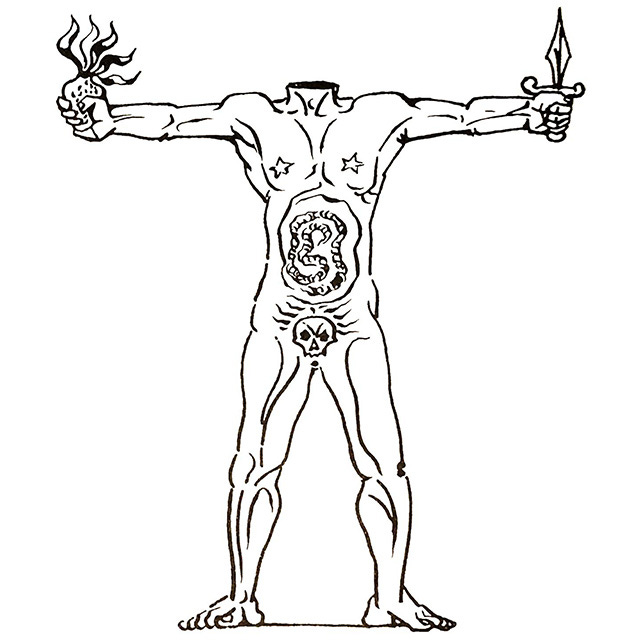
I wish today’s man-made horror beyond comprehension really was an April fool, but it’s in Wired magazine and has the grim quality of being something utilitarian materialists would actually think is good. A new startup is seeking to develop genetically engineered, non-sentient living “organ sacks” for medical experimentation, in response to the phasing-out of animal testing by the Trump administration.
Through genetic engineering, the startup aims to try and develop agglomerations of living animal tissue, just without the brains, in the hope that these can then be used for medical testing without causing pain to actual animals. The report suggests that in the future this process could then even be applied to human tissue.
It hadn’t occurred to me that someone in biotech might take Bataille’s Acéphale project as an instruction manual, but here we are. Wired reports that ending the pain and suffering involved in animal testing is a key driver of the project. Reading this, my first reaction was to think it a fine worked example of how terminall modern moral reasoning is hamstrung by the prohibition on Scholastic metaphysics, or more colloquially, “Thomophobia”.
This is a concept I elaborated in my recent First Things lecture in Washington, DC: the methodical elimination from science, philosophy, and moral reasoning of every last trace of Aristotelian metaphysics, to the benefit of scientific experimentation but the detriment of our capacity to give words to moral intuitions that nonetheless remain as pressing as ever.
In that lecture I argued that the Aristotelian ideas of formal and final cause - that is, the nature (eidos) and telos of a thing - form part of the conceptual framework that was first bracketed and then suppressed, and finally rendered taboo, in order for scientific materialism to become the ascendant modern paradigm. From this latter perspective, things don’t have a nature or purpose, so provided they aren’t experiencing obvious pain you can do what you want with them. From this it follows that it’s perfectly fine to do animal experiments, as long as the animals are not in pain; logically, then, if you create blobs of living animal-origin tissue that can’t feel pain this is even more ethical.
In this context, then, the Wired article refers a little dismissively, to “the ick factor” people experience in response to creating amorphous, headless sacks of living organ tissue for medical research. It’s irrational to think this is gross! We’re the ones being ethical! But once you take off the Thomophobic mental straitjacket, and add the missing concepts of eidos and telos back into your assessment, what they call the (implicitly arbitrary and irrational) “ick factor” is perfectly coherent. It refers to the accurate perception that doing this violates a living creature’s formal cause - its eidos, the holistic thingness of it - and re-appropriates the resulting deformed thing for a telos to which it was never directed.
You might object: sure, but people have farmed animals for meat for millennia. But the same moral intuition shows up here, too. The Gary Larson joke about the “boneless chicken ranch” is funny because the idea is such a monstrous violation of chicken eidos:

Similarly, we intuit that the telos of a chicken is to chicken, which is to say to behave as chickens behave. Killing it for dinner cuts violently across this, which is why people prefer to buy their meat pre-packaged rather than having to catch and kill the bird themselves. Additionally, on the whole people prefer to imagine their dinner “had a good life” before slaughter, which is to say lived in conditions that enabled it to chicken, in line with its telos: scratching and pecking in an open yard, rather than jammed miserably in a overcrowded wire cage.
That is: people can still see formal and final cause. The fact that “organ sacks” violate both these dimensions of reality is the source of the “ick factor”, which is not irrational at all but a proper ethical response to a proposal based on a dangerously truncated metaphysics.
Intentional efforts to engineer deformations of a creaturely eidos, to ends with no connection to the originating creature’s telos, should revolt us. This reaction is not less but more rational, and ethical, than trying to create pain-free lab animals. The “ick factor” is wholly rational - just in the older, more holistic sense of rationality, understood as the human capacity to apprehend the true nature of things: a capacity which, despite the best efforts of scientific materialism, most people still haven’t lost.
On purely practical grounds it also might not work. The brain is part of the system and results may well be misleading anyway. To get back to the philosophy the hubris involved in thinking that they can produce something that will include all the right bits to give them the right answer.
Researchers are using organoids to great advantage. At one institution, the brain cells from a young person who died from glioblastoma have been used to produce brain organoids. With these organoids, medications are being test directly for their efficacy. The testing results are showing not only which approaches may be effective in stopping the tumor formation, they also are showing just how ineffective the mouse and rat brain models. I consider this to be a huge step forward for medicine. There will be much more of this to come. Eventually, maybe, we will be able to grow whole new organs for transplant from the recipient's own cells. Imagine a liver transplant, in which the transplanted liver, is "your own" or new a heart valve that is not mechanical...I could go on, but this makes my point. What would Aquinas and and Aristotle think of this? We cannot know, but my guess is they would be amazed and impressed.