

My regular morning dog walk often takes me along a track through a local woodland where, over the last few years, I’ve watched a dead oak tree begin its descent into the deep life of a woodland. It stood, dry and fungus-covered, until a winter of high winds, in which it fell. It has since lain beside the footpath, sinking gradually into nettles and undergrowth.
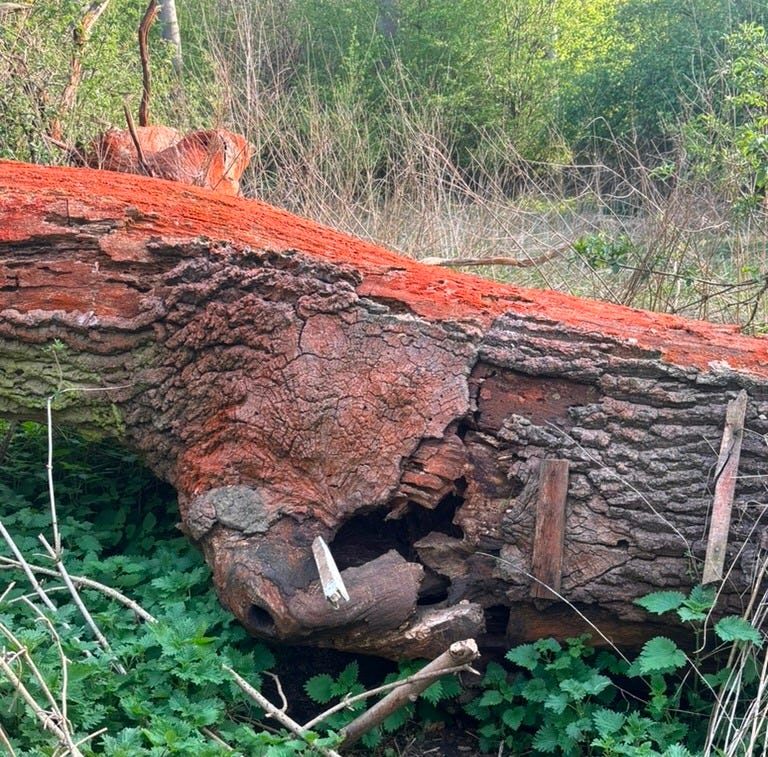
Not long ago, I happened to look more closely as I passed, and spotted something inside the hollow. I stepped closer, and realised I was looking at what appeared to be several rows of honeycombs! I could see no bees, though, so assumed I was looking at what had, at some point, been a wild beehive.
The combs were beautiful to look at, close up. The hexagonal structure is one of the most exquisite examples of form and function merging, perfectly, in the mathematical beauty of the physical world as it unfolds around us. The shape provides maximum strength and storage capacity relative to the material used, making it both pleasing to the eye, robust in construction, and maximally economical to build for the bees whose home it is.
Humans have long treated bees with a mix of veneration and gratitude, for their work as pollinators and the precious products of their hives - as well as their self-sacrificial willingness to sting and die, to protect the hive. The honey is sweet and nourishing, with medicinal properties; beeswax has countless uses in craft, preserving, polishing, waterproofing, and lighting. Producing a clear, bright flame and sweet scent, this comparatively precious wax has, traditionally, been the material of choice for sacred candles.
The symmetry and precision with which bees create their cells further supplied a source of wonder, poetry, and metaphor - including, especially, for scholars. In the ages before mass-produced print, which is to say up to the sixteenth century, scholars relied on memory training to store important material for easy reference. This is a form of meditative practice that involves creating mental visualisations, in which important ideas are “placed” for recall. A common metaphor for this activity was the work of bees, flying out to collect nectar and storing the sweet treasure in their honeycombs.
This intimate relationship between bees, wisdom, work, and Christian piety resonates throughout Christian tradition. Bees are a symbol of Mary and associated with St Ambrose, and early Bishop of Milan, who converted St Augustine. From Old Testament onward, honey is associated with God’s provision, including nourishing St John the Baptist in his wilderness time. Meanwhile the beehive is often employed as an ideal symbol of the church as orderly community.
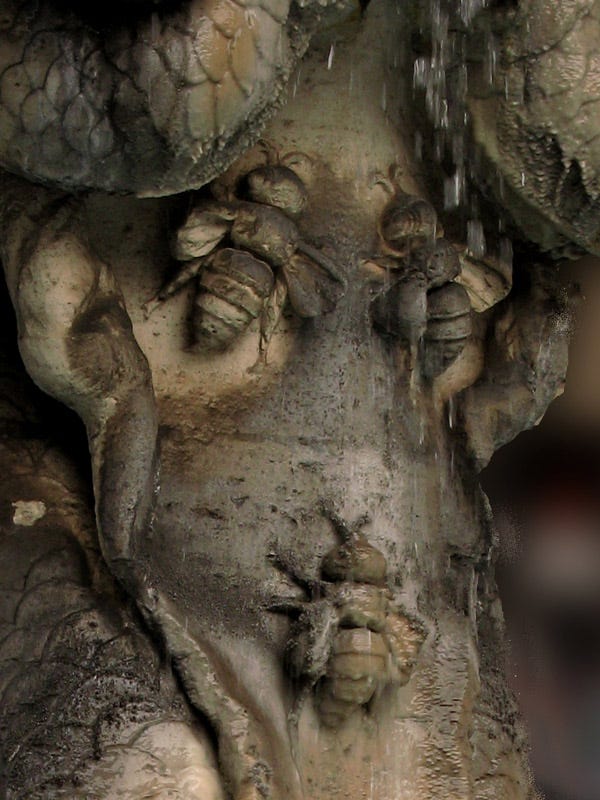
No wonder, then, the bee was adopted as emblem of the Barberini family, Florentine nobles whose shield, bearing three bees, appears in multiple locations throughout Rome, including stained-glass windows, carved pillars, and even books:
As well as buzzing through Italy’s aristocratic symbology, these most meaning-laden of creatures even make an appearance in the Catholic Easter liturgy, in the Exsultet where the new Paschal candle is offered up:
Therefore in this night of grace, O holy Father,
the evening sacrifice of this incense;
which, by the hands of thy ministers,
holy Church doth lay before thee
in the solemn offering of this Candle,
made from the work of bees.
But we already know the praises of this pillar,
which for the honour of God
the sparkling fire doth kindle.
Which, though it be divided into parts,
suffereth not the loss by borrowing of its light.
For it is fed by the melting wax,
which bee the mother hath wrought into
the substance of this precious Candle.
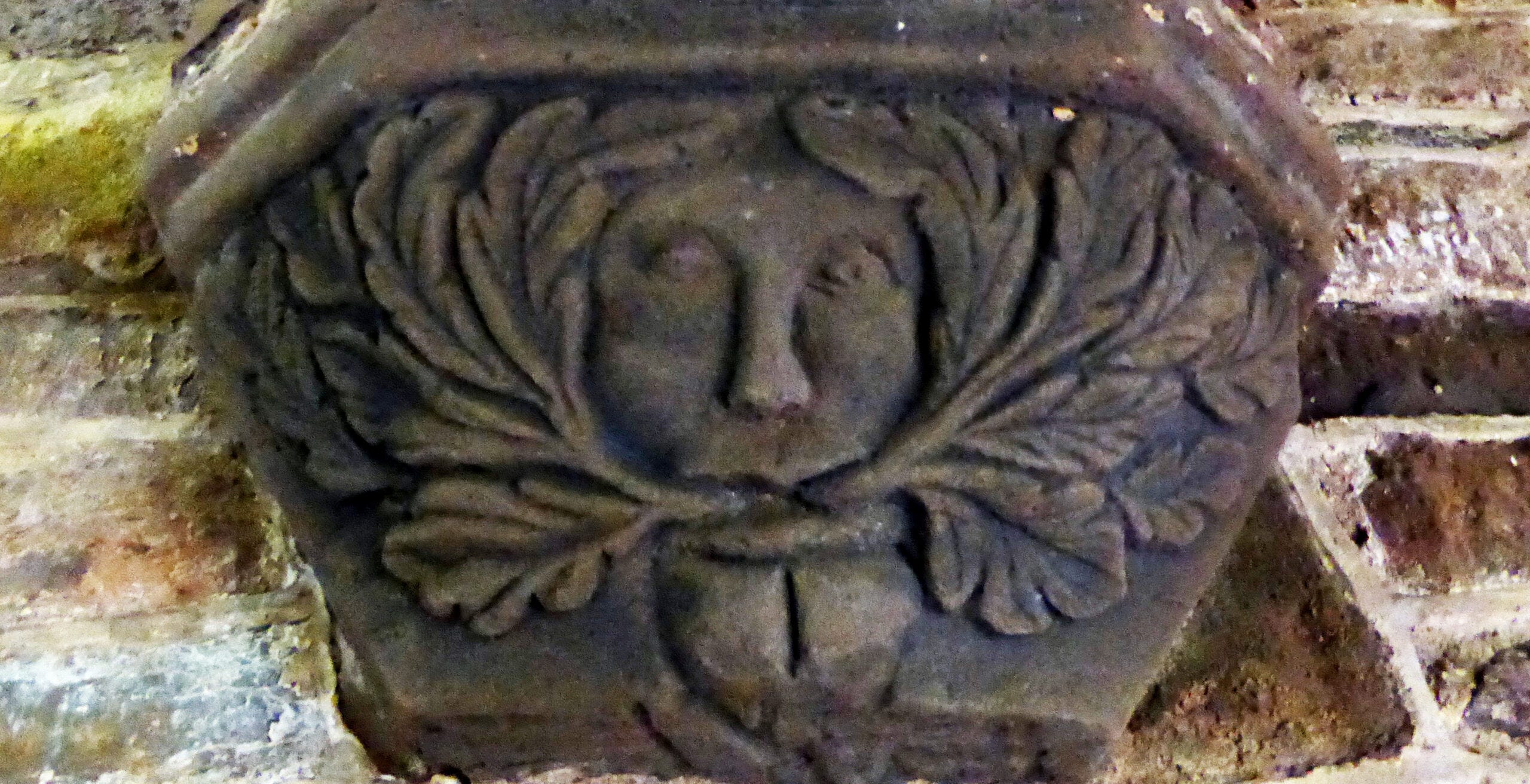
With all this in mind, passing that fallen tree and its empty-seeming honeycombs seemed to me at the time a mournful symbol. The oak tree has long been woven through English folklore, whether as the timber that built our early modern Navy, the tree that sheltered a fleeing king, the “Royal Oak” of many a long-lived hostelry, or the leaves that surround the Green Man, carved into pews and pillars and overhead beams in churches up and down the country:
So a fallen oak tree housing an abandoned beehive felt like a perfect symbol of emptiness twice over: a fitting picture, it seemed to me, for the sad mood of hollowness and technocratic mismanagement that besets my poor country in the current year.
Imagine my surprise, then, when I walked past the same hollow tree earlier this week.