

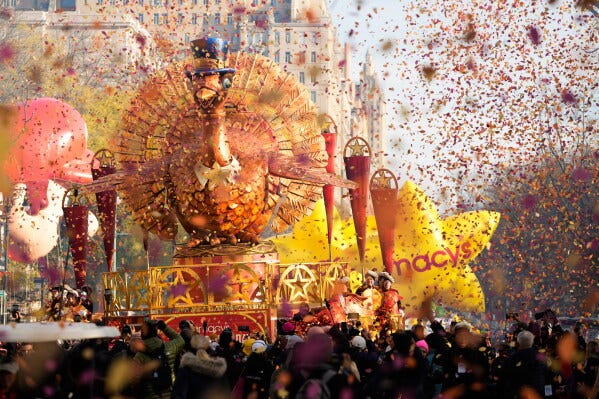
The extent to which the whole Anglophone internet is now functionally one place can be seen in the fact that the London Times (see how I have to qualify that?) has reported on the postponement of Macy’s Thanksgiving parade. It was due to take place today, but has been deferred till Saturday due to forecast high winds.
The report is also correct not to bother explaining what “Thanksgiving” is, as they would if British and American culture were still meaningfully separable.
I’m not dunking on Thanksgiving parades. You do you, America! I hope you’re all having a lovely time today. Nor will I be spending this article moaning about the transatlantic transmission of festivals. But I do want to talk about why, properly understood, feasts really do have to belong to a place, at a level which only partially allows for transmission via the internet. This isn’t because such transmission is necessarily bad, but because feasts have to be organised by guilds.
What prompted this line of thought is the manifest shitness (I choose the word deliberately) of every British attempt at a “holiday markets”. One of these, in Cornwall, recently hit the headlines for being so spectacularly disappointing that the organisers were forced to apologise to stallholders.
The bone of contention was how dramatically the AI-generated promotional materials, viz:
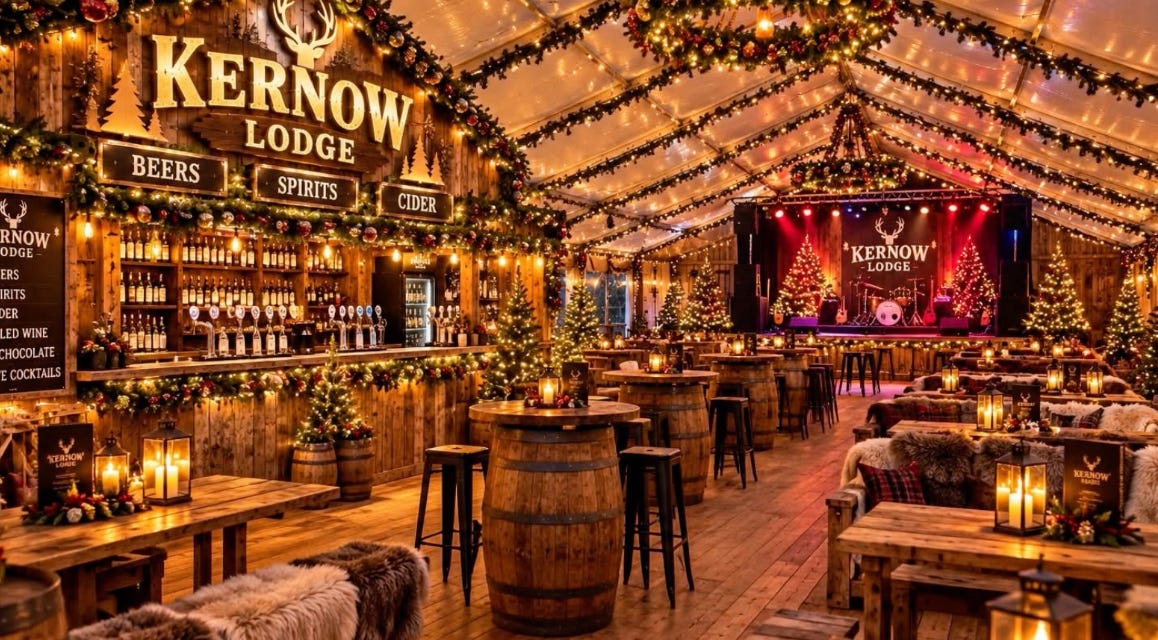
…didn’t line up with the reality, viz:
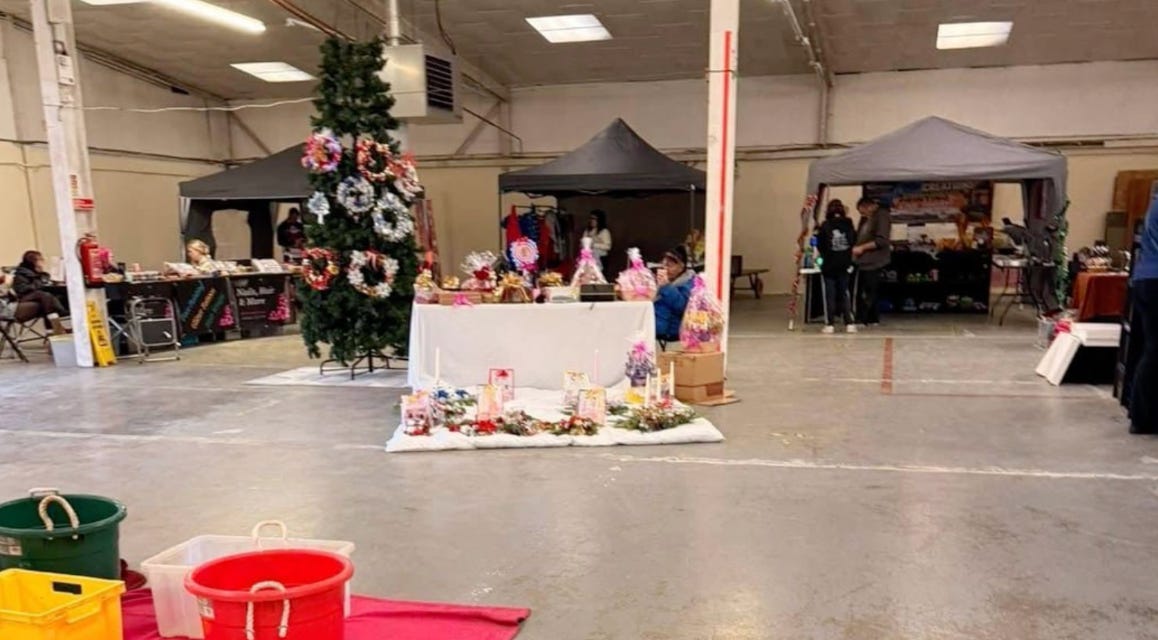
Oh dear.
This follows in a long tradition of disappointing British “Winter wonderland” events, beginning with the inaugural “Winter Wonderland” in London, in the 00s. By an accident of my chequered pre-journalism career (ha!) I happened to be on that benighted event’s PR team. Disaster doesn’t even begin to describe it. I just remember being cold, exhausted, and shouted at by literally everyone, especially people who’d paid for tickets, for about 18 hours straight.
Subsequent such events have continued the tradition of being rubbish. But they’re bound to be rubbish, because the whole thing about events of this kind is that they can’t be organised for profit. They have to be organised by guilds.
In The Stripping of the Altars, Eamon Duffy describes what this looked like, in the hyper-local pre-Reformation English “gilds” which coordinated funds and arrangements for processions, feasts, events, supplies, decor, and other important elements of the liturgical calendar, in local communities across England. Gild activities could include supplying candles, paying the salary of a special priest whose job was to pray for the dead, decorating the church, altar, or other objects or items for special events, or arranging food and drink for feasts.
One such regular event was Rogationtide, “beating the bounds”, which involved a formal procession around the edge of the parish, reciting Scripture, culminating in (inevitably) everyone getting tanked up on cakes and ale. But there were loads of events like this, to the point where businesses began to complain in the late Middle Ages that it was impossible to get anything done, because people were always stopping work for some feast or other.
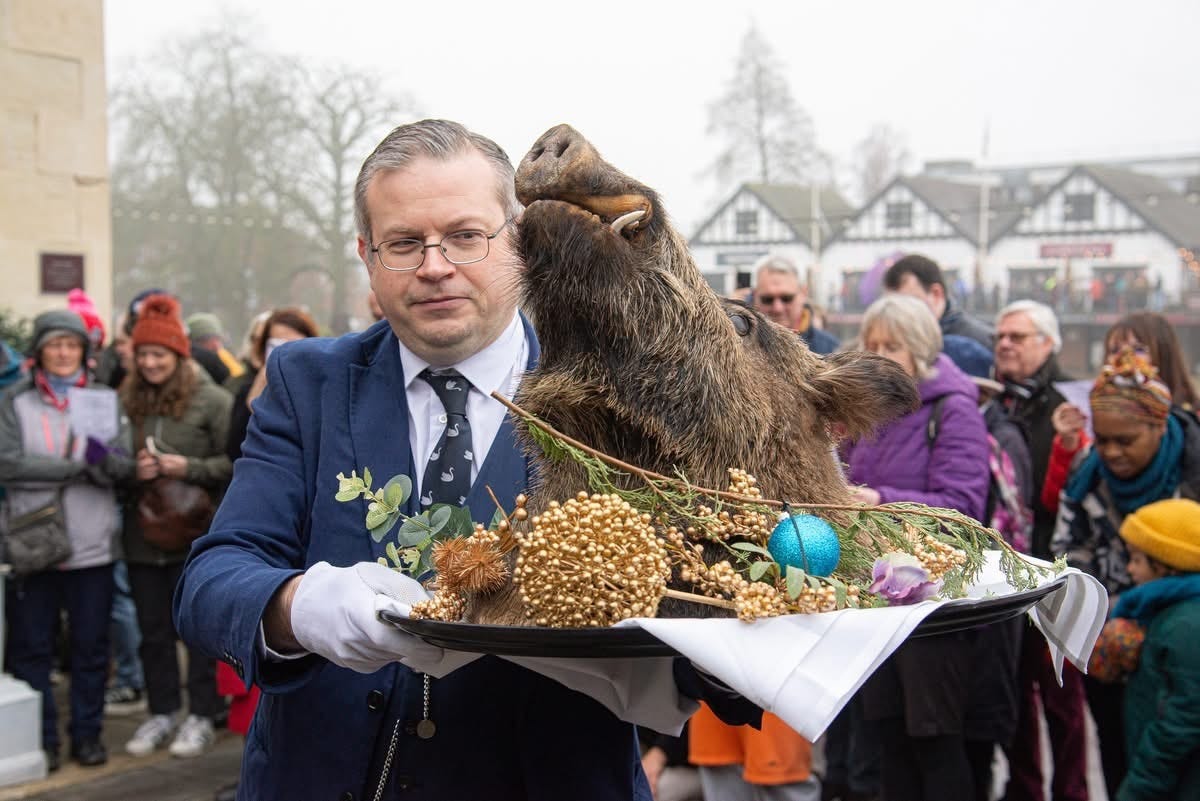
Some remnants of these traditions survive: for example the Boar’s Head Ceremony, which still takes place in numerous locations in England. In Bedford it happens on Boxing Day, and involves morris dancing, the Mayor, and a carvery at the Swan pub1. (As you will see, roast meat is a consistent theme in events of this kind.)
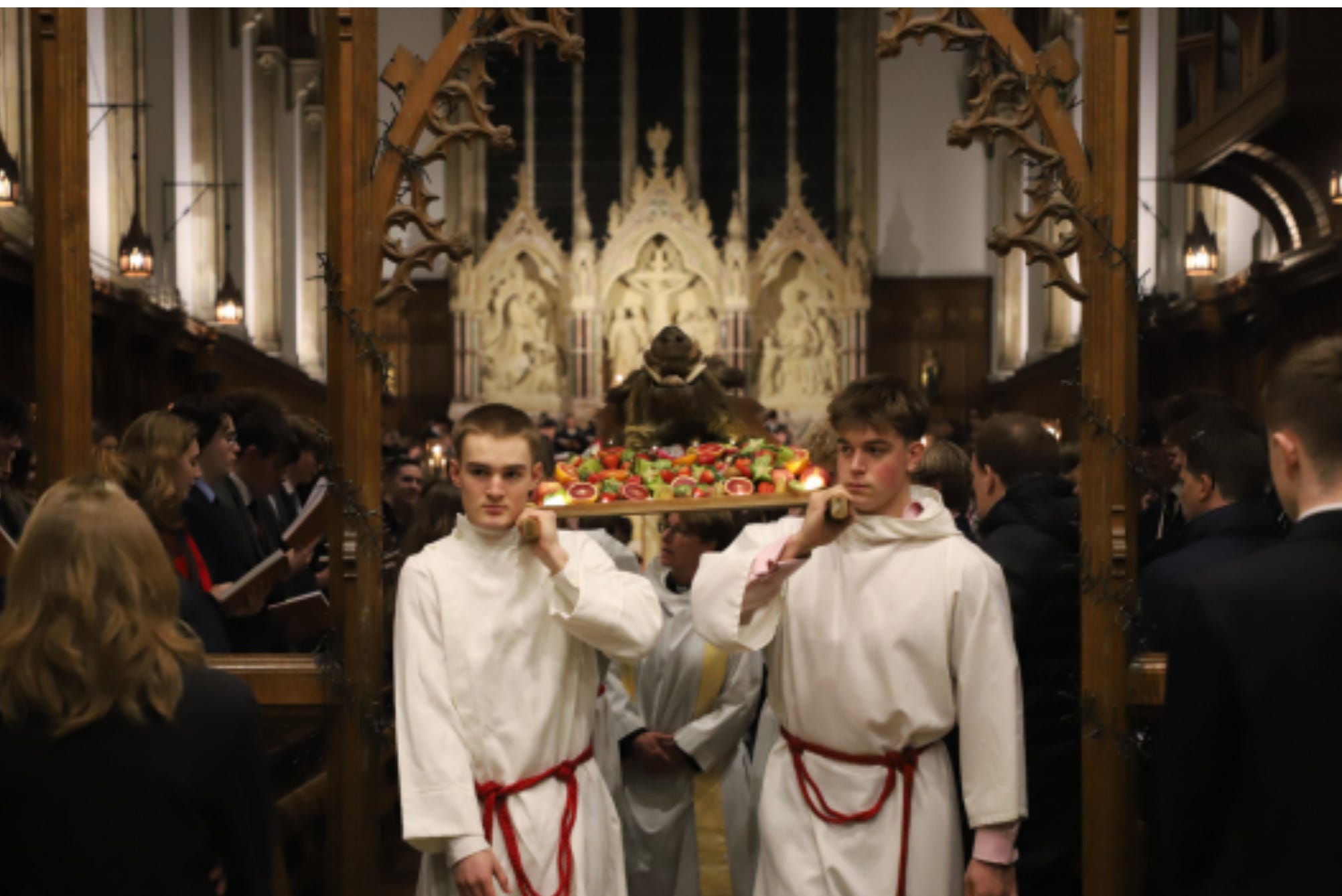
Here’s the Boar’s Head Ceremony at Hurstpierpoint College in Sussex, usually held on St Nicholas’ Day, ie next weekend. Another version is performed every year at Queen’s College, Oxford, at the annual Boar’s Head Gaudy, roughly two weeks after.
In the Oxford event, legend has it that a 14th-century Queen’s College student was on his way to church on Christmas Day, when he was charged by a wild boar. Unable to draw his sword in time, the quick-thinking nerd saved his bacon (sorry) by stuffing his copy of Aristotle into the beast’s jaws.
I dare say there are classics teachers living today, who will nod in sad recognition at the experience of having to force-feed Greek philosophy to pigs in order to survive. Nonetheless, this origin-story has shot straight into my personal Top 10 Things That Never Happened, Even In The Middle Ages. But who cares? It’s a feast, and beyond a certain point feasts are (or should be) self-sustaining.
Similarly self-sustaining is the centuries-old ceremony in London, whose slightly less fanciful origin-story is that a butcher’s guild was granted a licence to rinse offal in the Thames in the 14th century, in exchange for presenting a boar’s head to the Mayor every year. The ritual is still performed every year by the Butcher’s Guild in the City of London, where it’s not a Christmas thing at all but rather happens in March.
Here’s the 2026 procession, bagpipes and all:
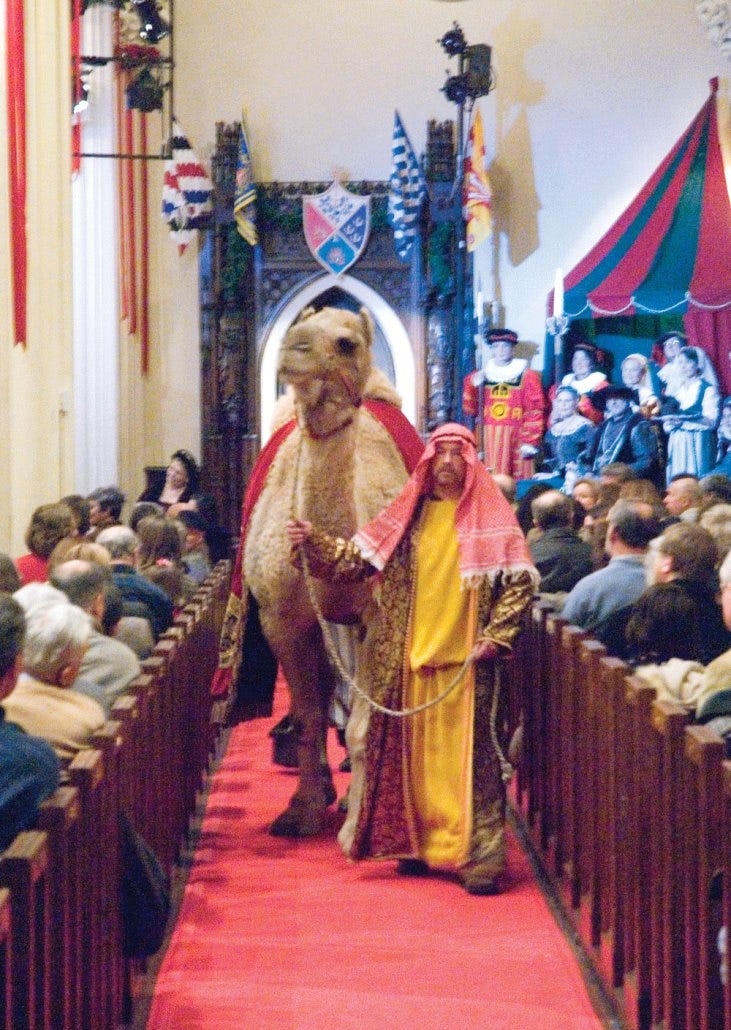
Now, you might say this is all just silly. That hasn’t stopped Asylum Hill Congregational Church in Hartford, CT from adopting the Boars’s Head Ceremony, in an event which (impressively, if confusingly) has been known to include a live camel.
But complaining about silliness entirely misses the point.
Look more closely at the City of London, and its guilds, and you’ll see a sociopolitical architecture that is both ancient and still remarkably effective, albeit somewhat modified in its activities since the Middle Ages. The City of London Corporation is in effect a semi-independent city-state within greater London. It has its own police force, and governs five bridges and 11,000 acres of green space including Epping Forest and Hampstead Heath. Though the residential population is small, millions more work in the City every day, so things can’t fall over or not work properly. The City is also magnificently un-democratic in any modern sense. Businesses can vote, guild membership is obtained via networking, and its social calendar is a byzantine web of dinners, events and - yes - bizarre rituals such as the Boar’s Head Ceremony. But I don’t think it’s fanciful to draw a straight line between the rituals, including comical ones, and the capacity to sustain a tight and enduring civic fabric.