

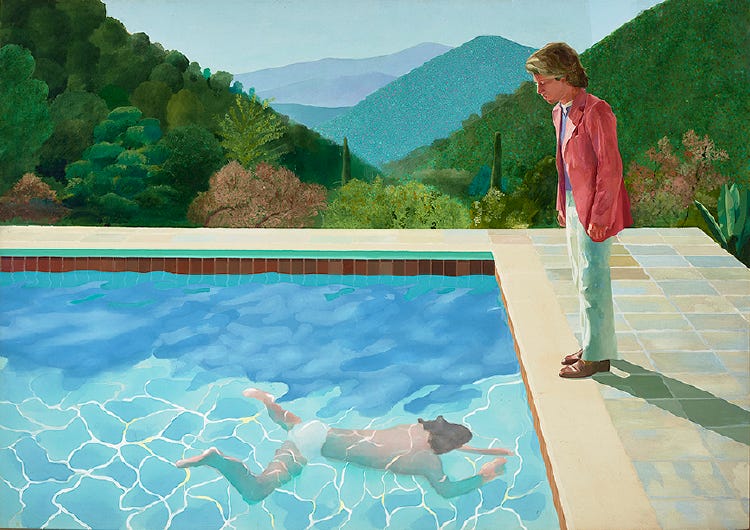
David Hockney, one of the great British painters of the twentieth century, died last week. There’s a lovely elegy for him in the Times, by his longstanding friend, the critic and broadcaster Melvyn Bragg. One line stood out to me, on Hockney’s attitude to the expressionists and modernists. Bragg writes:
He had no time for the anguish and angst of the expressionists and the modernists. He was drawn to real things, joyous things, natural and human. Once he overheard an art expert making a derogatory remark about artists who painted tulips. “Actually it’s very hard to paint a tulip,” he said. “Have you tried?”
Hockney was right, as anyone will know who has ever made a serious attempt to draw or paint from life. Difficulty aside, though, the subtext to this exchange is a moral one. The “art expert” in this anecdote was, however obliquely, making a moral assessment of drawing from life. He wouldn’t be the only one: at this point it’s more or less taken for granted, among people who consider themselves sophisticated appreciators of art, that being able accurately to draw and paint how people, objects, or landscapes look doesn’t necessarily evidence artistic merit, but mere technical skill.
Commenting on the Bragg elegy, the Revd Professor Andrew Davison, Oxford’s Regius Professor of Divinity, picked up on this substrate of moral assertion, identifying it as, in truth, anti-moral: “So much that is sick about contemporary culture is summed up in this distain (sic) for painting tulips.”


So here we have two opposing views. One claims there is no moral value in painting the appearances of things. The other argues that this viewpoint itself expresses a deep sickness within contemporary culture. But I wonder: is there perhaps a via media here? In my view, our problem doesn’t exactly come from not wanting to do naturalistic paintings. That loss of interest in the appearances of things in fact took place some time ago, around the turn of the twentieth century, and is linked to the advent of electricity and also of photography. No: our problem lies in having abandoned artistic naturalism, without restoring metaphysics. And there are important conclusions to be drawn from this insight, for those who wrestle with the question of where art should go next, from our current confused and exhausted moment.
I had the pleasure of briefly meeting Revd Davison recently, at Pusey House. He is that extremely rare theological creature, an Anglican Thomist; as such, I think it highly likely that he’s more alert than most to the importance of metaphysics. But this can’t be said for many in the world of modern art, which is wrestling with a problem only secondarily about art, and much more fundamentally about a metaphysical question: do things have an essence in any sense distinguishable from their appearance, or our ideas about them?
This question is hundreds and hundreds of years old, and was first contested back in the 13th century by William of Ockham, when he argued that positing any kind of stable essence to things imposed artificial constraints on God’s freedom to act as He pleased, in His creation. The countervailing position, most famously expounded by St Thomas Aquinas (and here I am a bit worried Revd Davison will be along shortly to give me a B minus for my sketchy summaries), was that no: things do in fact have a form or essence, independent of the ideas we ourselves form about them. They also have ends, which is to say they are directed.
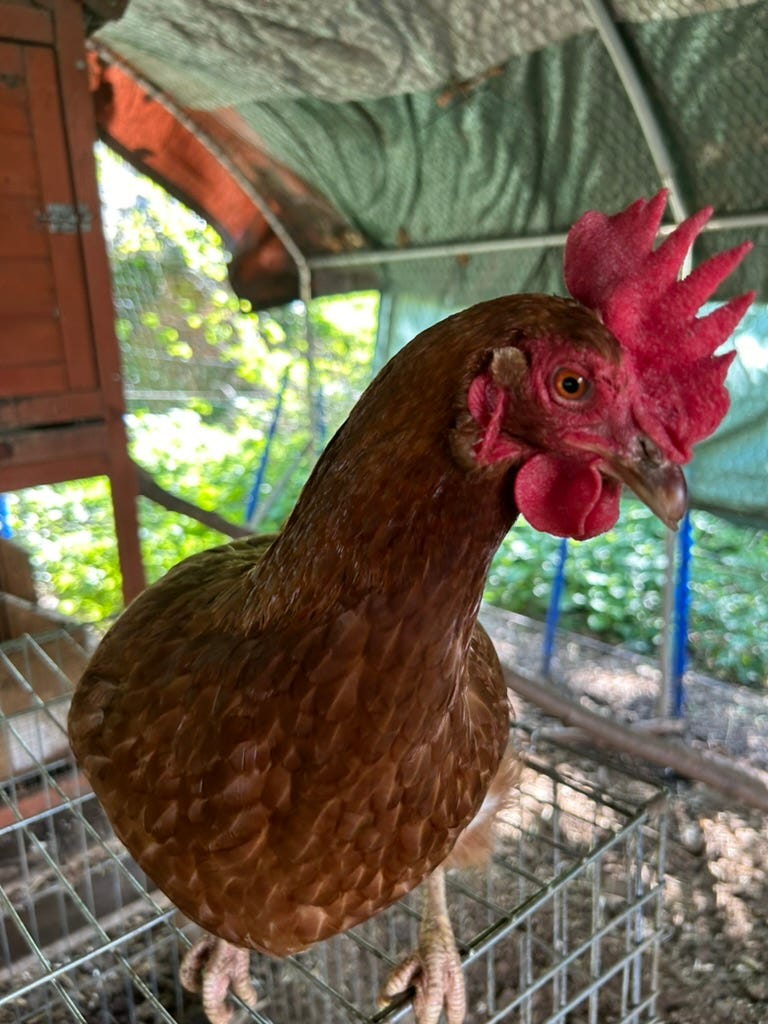
The chicken-ness of a chicken is just as chickeny, regardless of my perceptions of that chicken. Its purpose is to chicken. Here is the obligatory photo of a chicken, chickening:
I’m sure it’s clear enough to all of you by now that I’m emphatically Team Aquinas here, and not Team Ockham. In This House, the nature of chickens is a frequent source of joyful contemplation. Regular readers will also know that I love to bang on about the way form and ends were abandoned as categories for study or research, as a key precondition for the modern scientific revolution.
It’s too much of a sidebar for this short essay, but in The King and the Swarm (published next year) I’ll make the book-length case that this and much else besides was downstream of the print revolution. In the wake of this, a new and more empiricist mode of thought was normalised, that developed Ockham’s original challenge to focus on what is accessible to the senses, downplaying theories about the essence or nature of what is perceived as a distraction from the real business of research.
This narrower conception of “reality” is the version represented, often with astonishing skill and beauty, in the naturalistic schools of painting that began to flourish from the Renaissance on. These culminated in works of astonishing skill and precision, such as the sea-paintings of the 19th-century artist Ivan Aivazovsky:
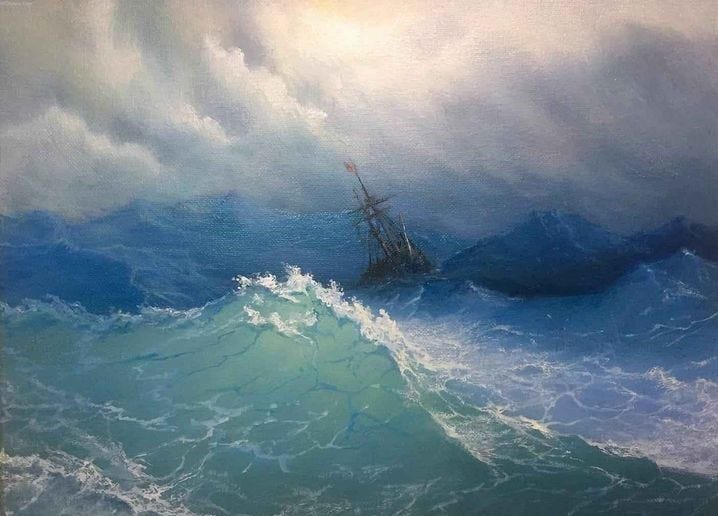
For anyone interested, there’s a great discussion of Aivazovsky’s work here by the contemporary artist and printmaker Alexander Adams.
Photography was the beginning of the end of this kind of naturalism. Why pursue a perfect representation of physical appearances in painting or drawing, when you can point and click with a camera? But the real death-knell was electricity. The great prophet of technology, Marshall McLuhan, foretold all the way back in the 1960s that electricity was the beginning of the end of the print revolution, and particularly of the way print (really, mass literacy) shifted Western cultures from “the magical world of the ear” to “the neutral world of the eye”.
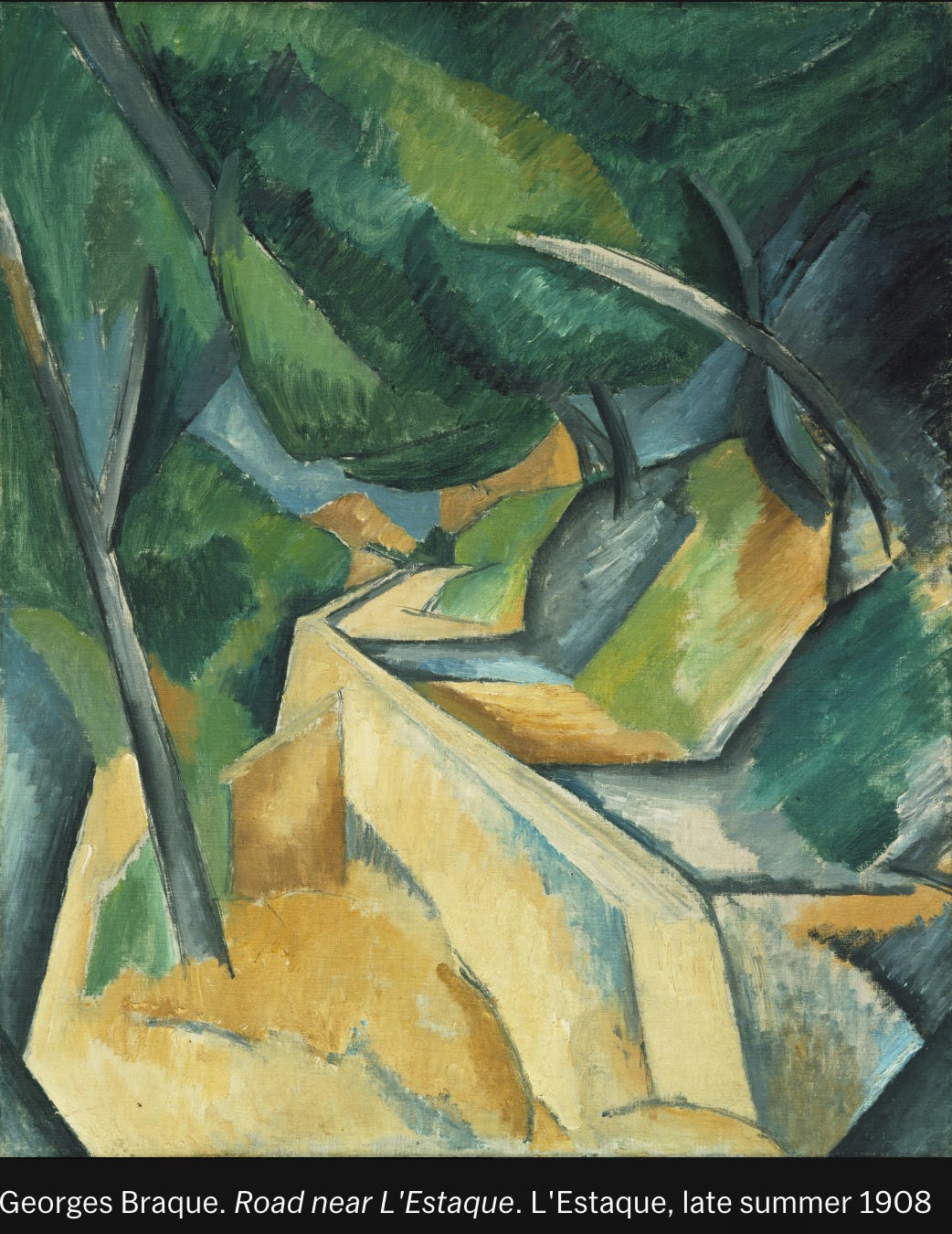
Photography was already driving artists to differentiate their vision from pure naturalism by the mid-19th century, but the eruption of radical subjectivism into painting via Expressionism, Cubism, and the rest kicked off after the world began to go electric at the turn of the century. It’s almost always the case that artists intuit the direction of travel before anyone else, and this was no exception. By the early twentieth century the most sensitive artists had abandoned pure naturalism, and were instead moved to pain inner topographies, or - as with Cubism - to paint the same subject from multiple superimposed perspectives:
For the sake of space I’m not going to try and recap the entire history of contemporary art after Cubism. But one of its knottiest problems is this: if “art” is no longer naturalistic, what precisely is it supposed to depict? Recall that the modern worldview was built on explicitly rejecting the metaphysics of form and ends, essence and purpose. We can still enjoy painting or drawing the appearances of things, even if they don’t have an essence or purpose.
But if photography does a better job of capturing appearance, and electricity has (as McLuhan put it) “extended our central nervous system itself in a global embrace, abolishing both space and time” and throwing us out of neutral objectivity back into the immediacy of enchantment and emotion, then what is left for artists to represent, if they don’t have recourse to essence or ends?
The answer, over the course of the twentieth century, has been ever-escalating levels of abstraction, involution, and, latterly, nihilism, culminating in straight-up deathworks such as Andres Serrano’s Piss Christ.
But it doesn’t have to be like that!