

Spending too much time online really does rewire your brain, especially if you’re very young. A Singapore study reported by Bloomberg showed a correlation between heavy screen exposure in infancy, and a non-typical pattern of neurological development that seemed linked to anxiety in adolescence.
“Don’t give your toddler an iPad” would seem to be a no-brainer, and yet here we are. What about adults, though? I’m pretty enmeshed in the internet, and have been for 25 years now. Katherine Dee calls it “Fairyland”. I love Fairyland. But as anyone will know who reads older stories about this realm, Fairyland isn’t all twinkly tinkly mini-girlies with wings, in tulle minidresses. It’s an eerie place, with perverse rules, and some straight up monsters - including the one on my mind today: the vampire.
This isn’t a woo-woo post. What I want to talk about here in mythic terms can also be described more abstractly using a phrase coined by the psychologist and addiction expert David Courtwright: “limbic capitalism”. In The Age of Addiction, Courtwright defined this as “a technologically advanced but socially regressive business system in which global industries, often with the help of complicit governments and criminal organizations, encourage excessive consumption and addiction”. I’ve referenced Courtwright before, in the context of the compulsive, antisocial, and wildly lucrative nature of the porn industry. But his framework encompasses a huge range of negative behavioural patterns, from junk food to gambling as well as porn.
It also includes great swathes of online behaviour. Last week’s online main character was Justin Murphy, an American internet personality who posted on X about how he doesn’t enjoy playing with his little kids. Murphy got absolutely dogpiled for his post, and my aim here isn’t to litigate the question he posted about, but to think about what’s going on when people get sucked into arguments of this kind.
Again, abstractly, this is “limbic capitalism”. It works via the incentive structures baked into engagement-based social media platforms, where the social media platform is always more engagement, and higher traffic, and is powered by a recursive feedback loop of algorithms and dopamine and behavioural modification. From a human perspective, this means some kinds of online behaviour are rewarded with more attention, engagement, amplification, and other kinds of social focus, producing a dopamine hit. Other kinds of behaviour won’t get you the same happy buzz. We talk routinely about “feeding the algorithm”, but wonder less regularly what, precisely, we’re feeding it. And here I think the best analogy really is the vampire: an uncanny entity that lurks outside your gait, waiting for an invitation to feed on your lifeblood - at least metaphorically so, in the form of your passions.
Consider: not all types of engagement are, well, equally engaging. The key is triggering some kind of strong emotion, meaning you can obtain this effect via positive-sum types of post. But the swiftest and often most rewarding (on its own terms) way of securing online engagement is often the dark stuff that makes people feel worse: angrier, sadder, lonelier, hornier, more inadequate, more fearful.
After I read the Murphy post about fatherhood, I nearly got caught. Then, on the cusp of posting a reply, it hit me that the dividend of ego satisfaction I’d get, from being mildly self-righteous to this guy I’ve never met, would almost certainly be outstripped by the emotional cost of letting the whole bad-tempered discourse live rent-free in my head, even for a few hours. I used to just get stuck in, but the more unhinged social media gets, the less appealing this feels, because of the cost of getting involved in arguments of this kind: a cost I’ve come to think of as “letting the vampire in”.
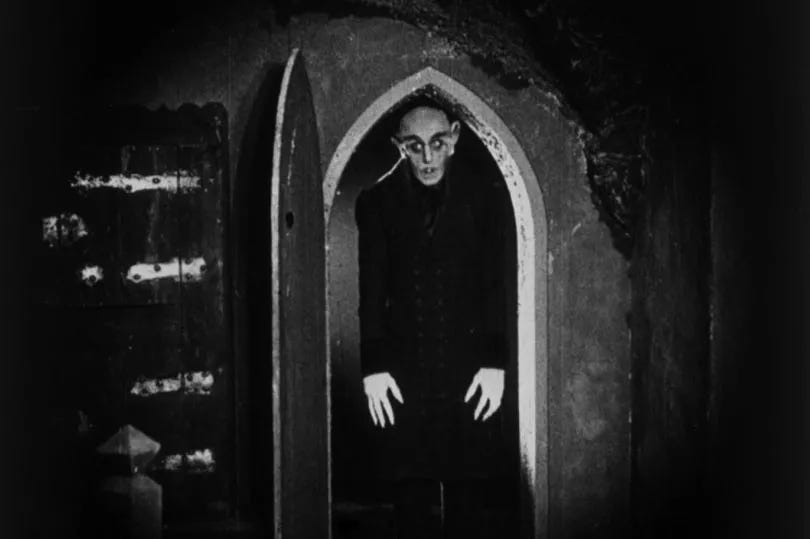
The lore varies, but these creatures are generally depicted as undead entities, often with uncanny powers such as hypnotic powers. They can assume the form of loved ones, as they plead at the window for you to let them in. They are repelled by garlic or Christian symbols, and extremely difficult to kill. And, importantly, they feed on the blood of living humans, canonically pretty young women but really anyone they can get their fangs on. Also importantly, vampire lore frequently has it that these entities are only able to enter your house, and feed on you, if invited over the threshold.
The analogy should be clear. What I mean, when I talk about “letting the vampire in”, is the precise moment of deciding to participate in the arms-race of disembodied dark emotion: the stock-in-trade of the “limbic capitalism” that flows so lucratively and addictively throughout social media. Dark emotion is so much more engaging that every incentive pushes us toward being the most angry, or most sexy, or most despairing, or grotesque, or whatever.
Inviting the vampire in produces an unmistakable feeling. If you’re at all online you almost certainly know it. There you are, walking the dog, or making dinner, or whatever, and realise you are mentally composing angry or scornful or scintillatingly witty retorts to people you’ve never met, on a topic that has the most glancing relevance to your real-world existence but which feels URGENTLY pressing and of the utmost importance. When you’ve invited the vampire in, this feeling can become all-consuming. Sometimes it brings a mood of dread, or silent fury, or deep depression. It never brings a mood of focus, joy, or peace. On the contrary, it will sap your focus, besmirch your joy, and interrupt your peace. Worse still, once you’ve invited the vampire in, it is very much more difficult to get rid of it.
It can take the (figurative) form of your ex; your mum; a wounded child; a desperate victim. It’s constantly scrabbling at the edges of that little glowing screen, pleading to be let in. Even positive-sum forms of posting tend to reward personal, intimate disclosure: baby photos, personal anecdotes, vulnerability: a slippery slope, that I’ve previously argued easily becomes another source of food for this entity to consume, without replenishment.
So let’s suppose you’ve let the vampire in, on some topic or other. Now what? Here again, vampire lore offers subtle but (in my experience) often effective suggestions for getting rid of it. It’s repelled by daylight, by garlic, by religious symbols; we might take these as metaphors for keeping normal, diurnal hours, staying grounded in physical reality, and praying regularly. In my experience these are all helpful remedies for that feeling I described above, of hauntedness and depletion, that comes from letting this thing feed on your passions.
But if you will visit Fairyland, prevention is better than cure. For what it’s worth, over a quarter-century online I’ve stumbled by degrees into five self-imposed rules for navigating Fairyland, without accidentally inviting any vampires in. I don’t always manage to stick to them, but when I do life is considerably less haunted: