

This week’s best memes have been ragging on Marc Andreessen, noted tech VC and “introspection” disrespecter-in-chief. Andreessen declared, in an interview, that in his observation having studied "Great Men of History” the one thing they have in common is that they don’t introspect. They don’t think; they just do. “People who dwell on the past get stuck in the past”, he said. “It’s a problem at work, it’s a problem at home.”
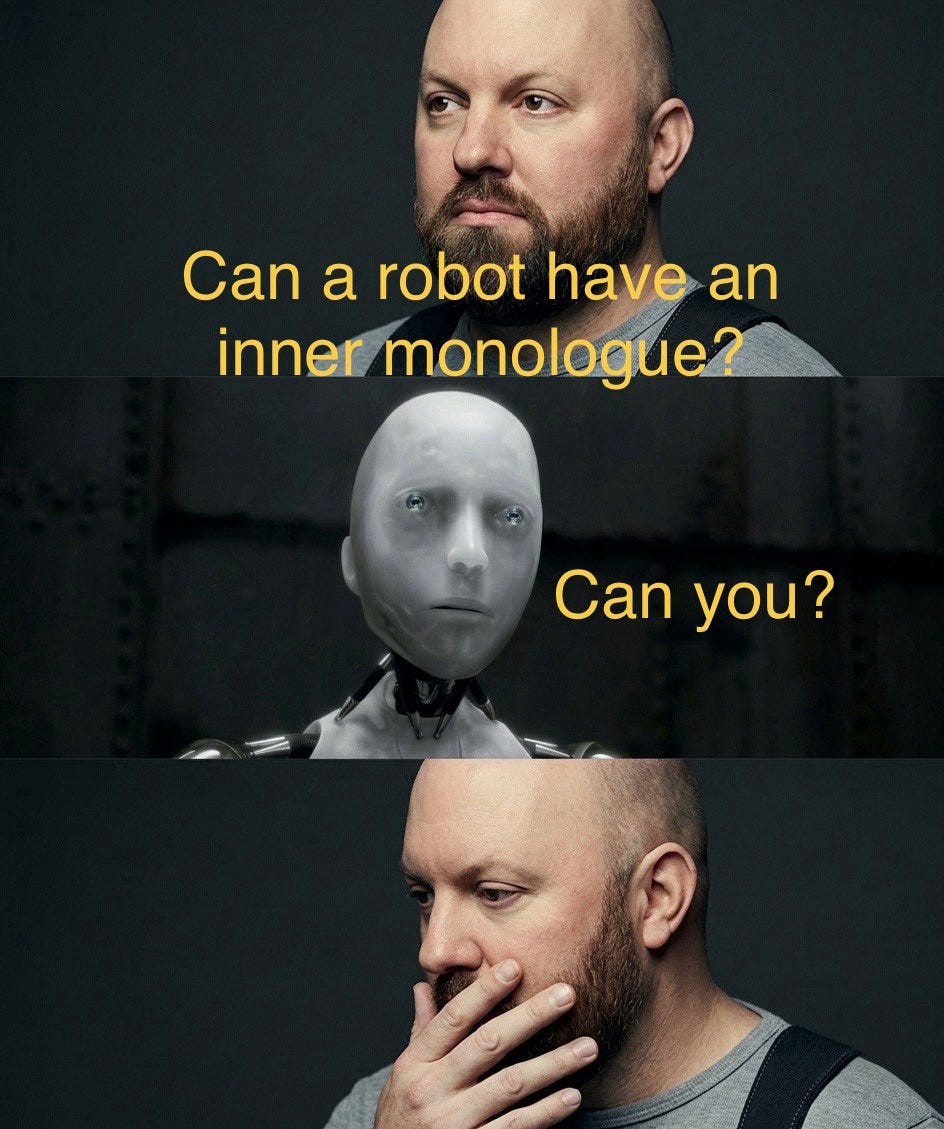
He then clarified somewhat: he is, he said referring to “all the modern misconceptions about introspection and therapy”. Andreessen argued that 400 years ago no one would have dreamed of introspecting in this way. In his account “Western Civilisation” invented the individual, a few hundred years ago. Then, though, Andreessen says, around the 1920s “this kind of guilt based whammy” showed up, mostly (he says) from Europe, specifically Vienna. He doesn’t quite say “Jewish” but I think he’s expecting people to infer that.
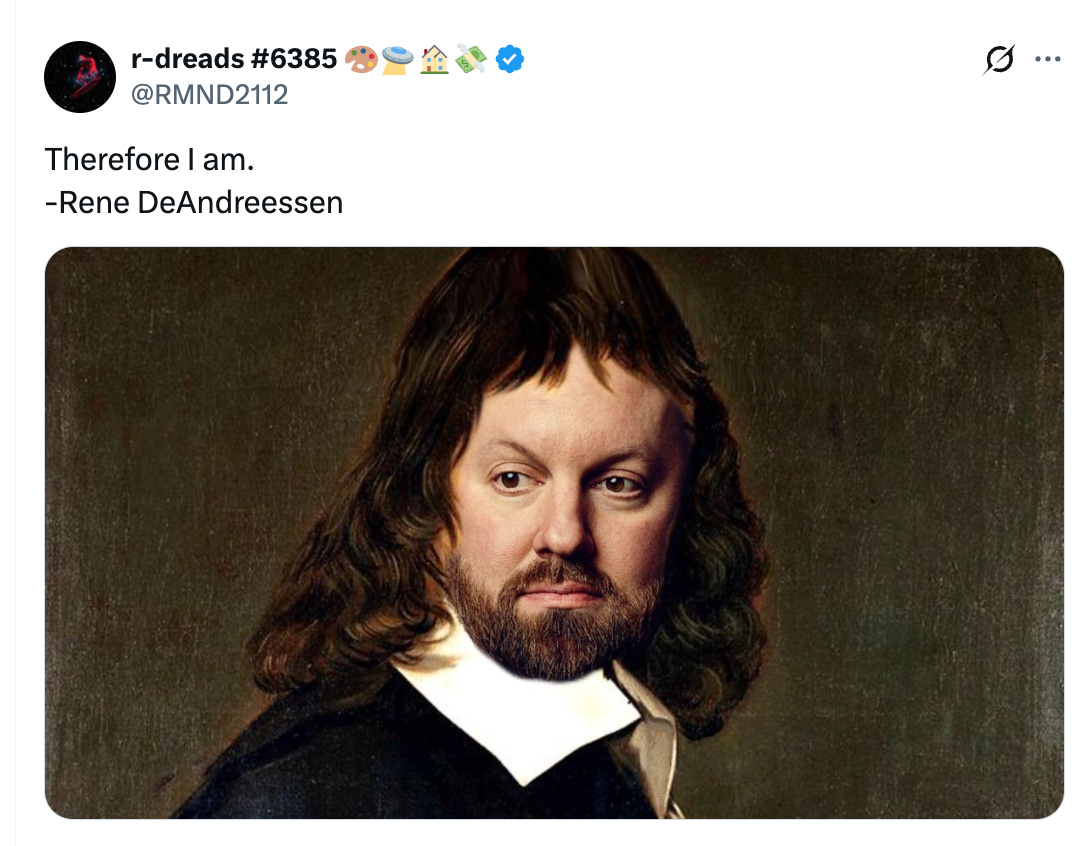
This resonates with a favourite talking-point for another “tech right” VC: Peter Thiel. Thiel spoke critically in my interview with him, as he has in other interviews, of the way something happened in the 20th century such that people stopped wanting to explore outer space and set about exploring inner space instead. Thiel situates this in the ‘60s, rather than as Andreessen does in the ‘20s, but it’s a similar refrain. Somehow people got more interested in feelings, and vibes, and inner life, and stopped building things in the world, and this is bad.
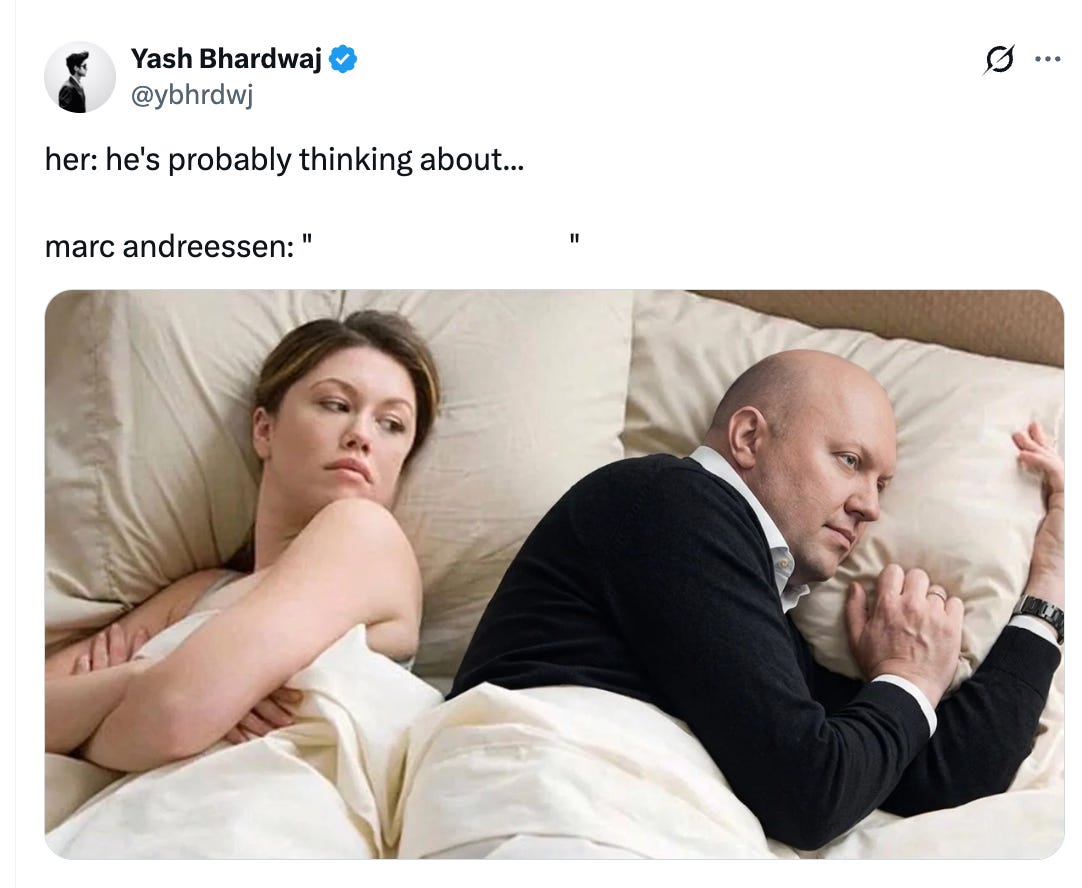
Andreessen got a lot of flak. Commendably, he understands that when you get main charactered, the answer is always to post through it. He doubled, then trebled down. Introspection, he says, is “neuroticism x narcissism x thumbsucking”. Science proves it! Someone wrote a book! Science tells us, apparently, that “the mind is flat”, and selfhood is an illusion. Everyone then went bananas, pointing out that there is really quite a lot of premodern literature and philosophy that describes and valorises the examined life.
He’s obviously mistaken to suggest we can collapse every human inner experience into neuroticism and navel-gazing. It’s also somewhat ahistorical to suggest that “the individual” was agentic and uncomplicated until Freud ruined it by inventing neurosis. Both the antecedents to The Mind Is Flat, and also to modern navelgazing, were both already visible back when Andreessen thinks the “individual” was invented at the start of modernity. But he’s not wrong about everything.

The “flat” self has its early modern antecedent in what Charles Taylor calls “Locke’s Punctual Self”. Writing over the ruins of medieval scholastic metaphysics, Locke wanted to give an account of inner experience without reference to humans as a substantial form in the Aristotelian sense. The fact that he was writing against this older tradition obviously problematises the idea that people centuries ago had no inner experience.
But more importantly, the solution Locke came up with was to suggest that our consciousness exists in successive points without these really being connected by anything real. This clearly prefigures the “flat” model of the mind now proposed by Pop Science. To make matters still more complicated, the failure mode Andreessen critiques is also already present in early modern literature. It is, in fact, the leitmotif of Shakespeare’s most famous play, Hamlet, written in the early 17th century. As Hamlet stands, knife in hand, dithering over whether to murder his hated stepfather at prayer, Hamlet’s tortured articulation of this failure mode: “Thus conscience doth make cowards of us all”. It’s hard to think of a neater encapsulation of the inverse correlation Andreessen alleges, between self-reflection and decisive action. And here we find it present right at the beginning of the era he frames as the salad days of “the individual” before it was hamstrung by neuroticism.
So the “flat” self in fact has a history, and a prehistory. The navel-gazing neurotic is far older than Freud. Both, in fact, appear not as successors to the happy salad days of The Individual as invented by Modern Western Civilization, ie Whig history, but as present from its inception. To my eye a much more plausible account of the emergence, flourishing, and decline of this model of selfhood - and, I hope, one that squares the circle between the Tech VC Self and its critics - situates the change not in Freud, or LSD, but media ecologies. In other words, Andreessen’s own home turf: information technology.