

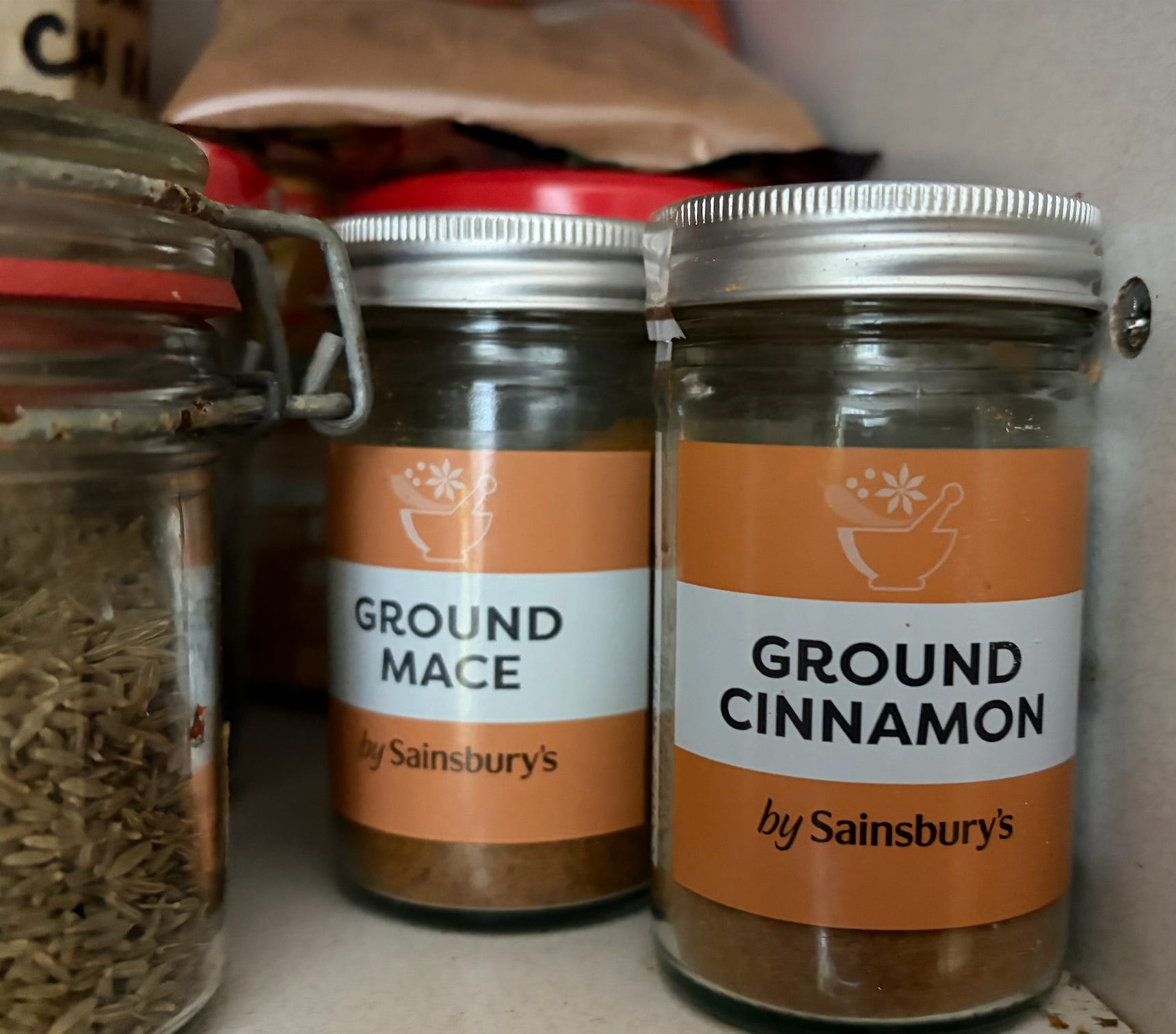
There are two kinds of cook: those whose spice jars are all identical and carefully labelled, and those whose spice jars are haphazardly labelled but different shapes and sizes, with the contents identifiable based on the shape and colour of the container.
I’m the second kind. My un-system works beautifully - until, that is, I end up with two identical jars holding similar-looking aromatics. This morning that happened with the adjacent jars of ground cinnamon and mace, with the result that instead of putting cinnamon on my banana toast, I sprinkled it with mace instead. The result was not unpleasant, exactly, but tasted too much like the smell of old church pews to be quite what I wanted for breakfast.
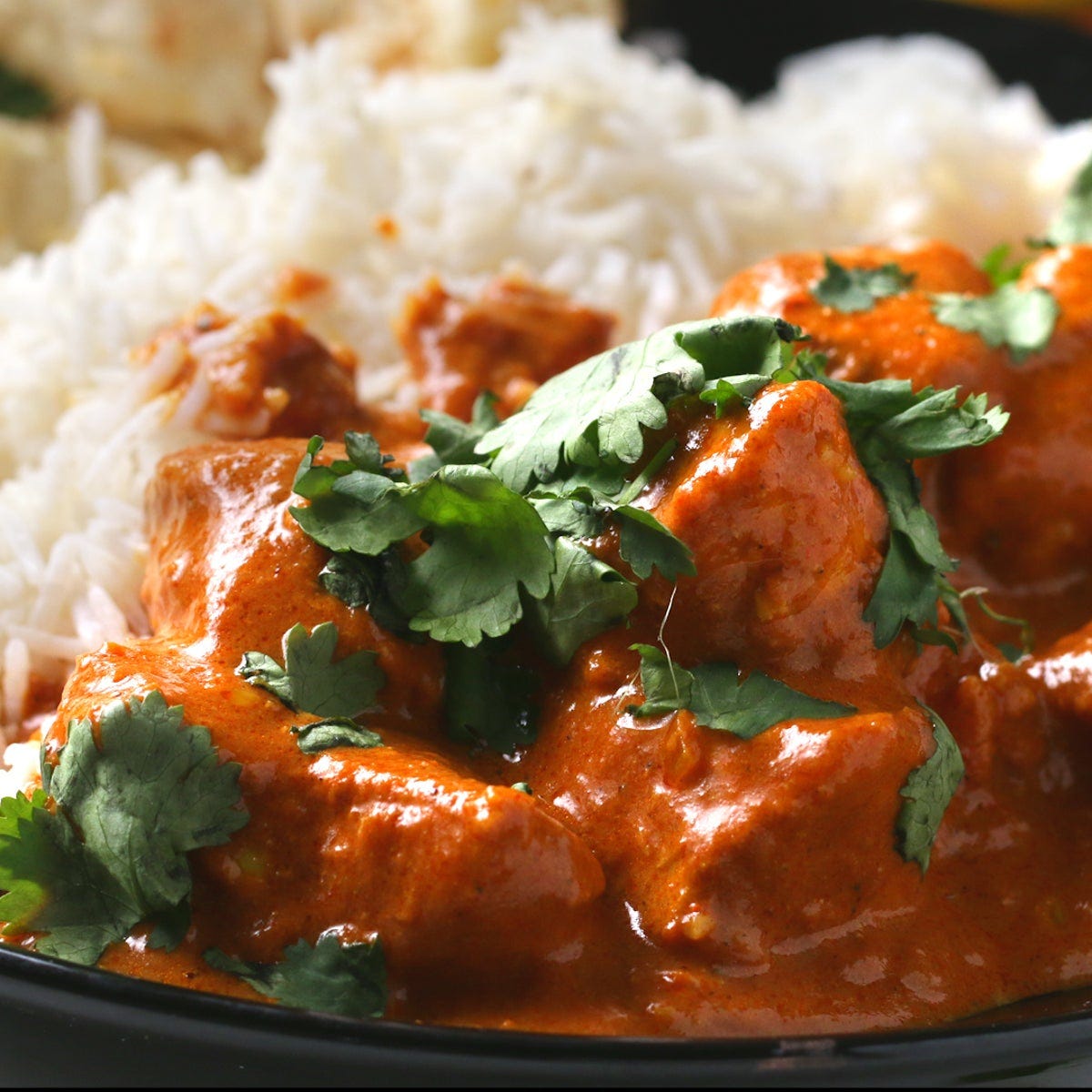
The smell of mace did remind me, though, about the long tradition of spice usage in English cooking. This shows up in the wearisome, never-ending internet argument about whether or not the British Isles has any indigenous traditions at all, or is merely an empty signifier awaiting enrichment from elsewhere, which crystallises in the emblematic dish, chicken tikka masala. Reportedly first invented by Bangladeshi chefs in Glasgow, this dish was hailed by Blairite foreign secretary Robin Cook as a true British national food. It is both delicious and, tediously, a hackneyed talking-point in the proxy argument about what culture is, and whether Britain has one.
Tikka Masala Discourse usually entails a subtext, to the effect that prior to the admixture of people from around the world British cuisine, and by extension our culture, was a tabula rasa of bland, lying dormant like Sleeping Beauty in anticipation of a spice-laden kiss from tastier overseas cuisines. One response is to big up roast dinners; another, more fringe response, is self-imposed dietary nativism: the Canadian anti-migration activist George Hutcheson, then dating the Youtuber Lauren Southern, was reported by The Atlantic to decline “food originally from nonwhite countries, such as ketchup, whose origins are in China”.
The only possible reason for doing something so stupidly self-limiting is, to my eye, if you’re inventing a spurious set of restrictions in order to lose weight. I suppose “GOOP, but racist” is probably as effective as any other form of dietary restriction in this sense. But is anything else about this frame quite right? Was Britain really a sea of bland stodge until the post-war Year Zero?
One of my intermittent book-collecting interests is culinary history. And if you poke around in vernacular cookery, it’s clear both that this is not so, and also that syncretism and hybridisation in cultures is a far subtler dynamic, than either the simplistic postmodern “everyone can live everywhere” narrative or that of its dogmatic opponents.
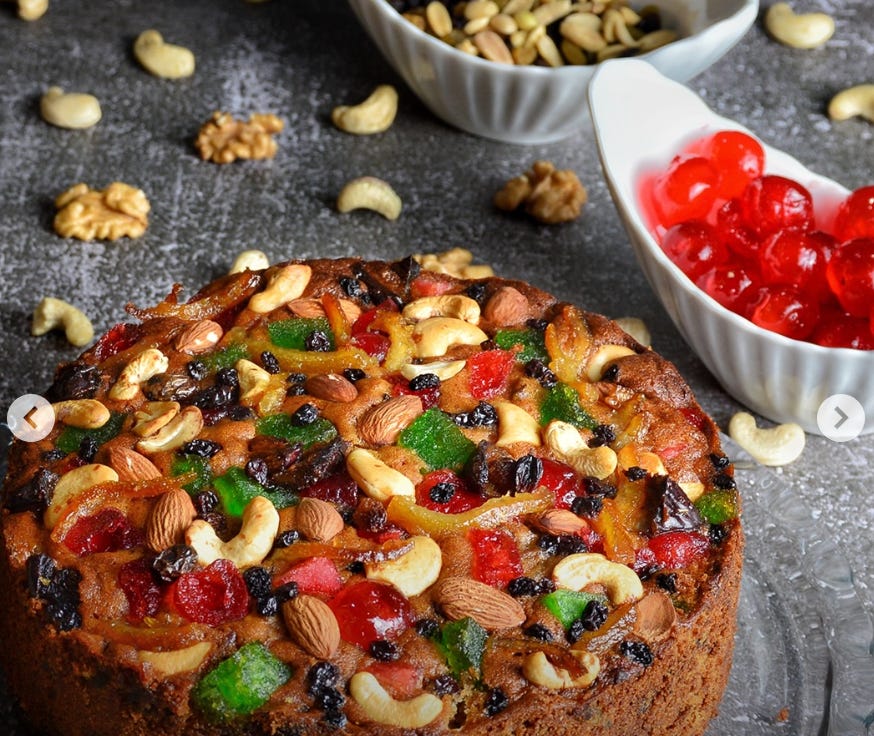
What actually tends to happen is that foodstuff or flavour is introduced from elsewhere, delightedly seized on, and its use then mutates by degrees to accord with local tastes. One of my favourite example of this in practice is the slow evolution of Christmas cake in Kolkata. Christmas cake is, of course, a very traditional English flavour: recipes in 18th and 19th-century English cookbooks go heavy on currants and raisins, sometimes darken the flavour still further with black treacle, then soak the resulting dense, bittersweet fruity slab liberally with alcohol.
I first learned from the historian Sumantra Maitra, a Kolkata native and author of Clio's Musings, that more than 75 years after Britain’s exit from India Christmas cake is still a popular seasonal treat in his home town. When I looked it up, though, it’s clear that the recipe has begun to evolve in line with local preferences and ingredients. Contemporary recipes often include elements you’d be mildly surprised to find in an English Christmas cake, such as crystallised ginger, cardamom, and cashew or pistachio nuts.
I love finding mutations of this kind. Something objectively delicious (such as Christmas cake) ends up, through the twists and turns of history, transplanted to a new setting, and takes root there according to the preferences and immediately available ingredients of that new setting. But the point here is a subtler one than “everyone can live everywhere”. Outside the wishful-thinking world of open-borders theorists, exchanges between peoples really do often entail the forces, frictions and assorted forms of power and violence that make up the warp and weft of human history. The story of the British in India wasn’t just a cosy one of Christmas cake and egg sandwiches (also, Dr Maitra tells me, still a popular street food there.) Nor is the history of migration from the subcontinent into Britain just a cosy one of adding spice to our boring national cuisine.
But while food really isn’t adequate as a metonym for the totality of what such movements encompass, at a level below the big-ticket items of money, power, and violence the history of hybrid food culture tells a story that’s at once more intimate, more porous, and much more ambivalent about who really “owns” culture, ever. However ambivalently it’s understood, in hindsight, the interchange between Britain and the Indian subcontinent was so extensive and longstanding that an entire subgenre of these cultural fusion dishes arose in its context - of which chicken tikka masala is only perhaps the best-known.
My source for a deeper understanding of this interchange is David Burton’s fascinating The Raj At Table.